Tripleseat
Your process isn't broken. It's just invisible.
Brand snapshot
Tripleseat Floor Plans (formerly Merri, now part of the Tripleseat family) sells 3D event design software to independent planners. The product turns a venue into a 3D rendering - tablescapes down to napkin folds, tenting, draping, stages, lighting - so the planner can sell the event to the client before it exists. The company's own line: “Bring 2D plans to life with beautiful 3D renderings worth a thousand words.”
The offer
3D event design software - unlimited events, unlimited exports, 2D floor plans and 3D designs, a catalog of 70,000+ rentals. The venue itself is built in 3D for free within 3 business days: “We can create any venue for you for free.”
Who buys it
Independent planners, 21–35 - the Vision Juggler - running weddings one weekend and corporate summits the next, holding five events in her head at once. She's pitched with PowerPoints and prayed.
Price/objection shape
Professional at $29/month, All Access at $39/month. The live objections are learning-curve fear (“another software to learn”), client-seriousness doubt (“will clients take a 3D plan seriously?”), and process inertia - PowerPoints and Excel work fine today.
The control
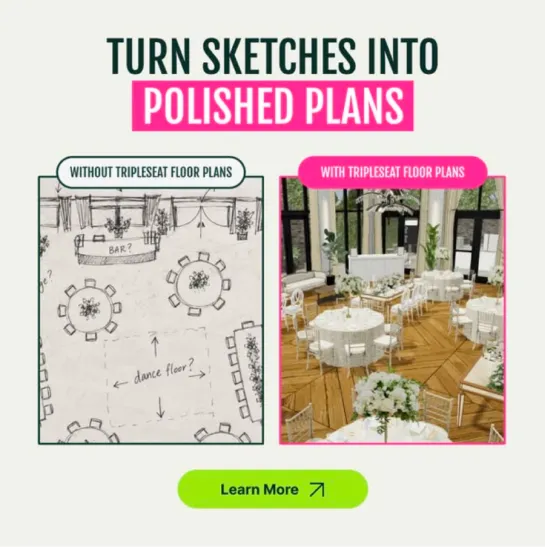
“TURN SKETCHES INTO POLISHED PLANS” (Library ID 2268906723893470) - the existing ad this study tests against. Before/after static: hand sketch “WITHOUT TRIPLESEAT FLOOR PLANS” vs. 3D render “WITH TRIPLESEAT FLOOR PLANS”; post copy “From first walkthrough to final setup, bring your event space to life.”
Diagnosis
The account is not broken. It is transformation-led where it should be workflow-led: the ads sell the output - the polished plan, the rendered venue - and none shows the Tuesday. Each lens names a gap a test can close.
Lens 1Awareness levels covered vs. missing
Awareness level
Covered today?
What is missing
Unaware
No
No entry creative naming the invisible-process pain
Problem-aware
No
No creative teaches where 3D planning fits a planner's existing week
Solution-aware
Partial
The before/after assumes the planner is already shopping the category
Product-aware
Yes
Feature proof (tablescapes, draping, lighting) speaks to comparers
Most-aware
Partial
Free venue build exists on the site but never appears in the creative layer
Read: the account starts at the solution and skips the problem. The largest pool - planners whose process works but whose vision clients can't see - is never addressed in its own language.
Lens 2Formats used vs. unused
Used
Transformation-led statics - the before/after and the 3D venue render - plus hotel-software statics for a second audience.
Unused
The educational infographic (workflow timeline showing the product's slot in the planner's week), the checklist/pill workflow (the Zillow pattern pulled in the reference set), and the handwritten strikethrough list (the Canva × Expedia pattern) - all three formats the reference set proves for teaching a new workflow to a busy audience.
Lens 3Positioning said out loud vs. left in the deck
Said out loud
“TURN SKETCHES INTO POLISHED PLANS” - the transformation, stated as a command.
Left unsaid
“We build it in 3D, free.” The single strongest risk-reversal in the offer - the venue built for you, no learning curve - appears nowhere in the ads. Also unsaid: “No templates,” the bespoke reassurance for planners whose value is custom vision, and the workflow itself - what Tuesday looks like with the product in it.
Also left unsaid
The client's yes. Every planner testimonial on the site converges on one moment - “the difference between a 'maybe' and a 'definitely yes'” - and no ad names it.
Lens 4Customer language mined vs. generic
The strongest language in the account's orbit is planner-native and procedural: “tablescapes, draping, lighting, drag and drop,” “pitched with PowerPoints and prayed,” “my secret weapon” (planner testimonial). The generic failure mode is transformation-speak - “polished plans” - which describes an output and proves nothing about the week. The concepts below keep the procedural voice and push it into the headline: the workflow named step by step, the objections answered in the planner's own words.
Line
Source
Why it matters
“We can create any venue for you for free.”
Planners page
The strongest risk-reversal in the offer - never appears in the ads
“Bring 2D plans to life with beautiful 3D renderings worth a thousand words.”
Planners page
The transformation, stated with specificity
“my secret weapon”
Planner testimonial
Planner-native proof - an insider's phrase, not a marketer's
“the difference between a 'maybe' and a 'definitely yes'”
Planner testimonials
The client's yes - the actual outcome planners buy
“pitched with PowerPoints and prayed”
Planner voice
The old way, named honestly
“tablescapes, draping, lighting, drag and drop”
Planners page
Procedural, planner-native vocabulary
“polished plans”
Current ad headline
Generic transformation-speak the concepts replace - an output, not a week
Category proof
A competitor ad its advertiser keeps funding past one full test cycle is a spend signal. Meta's own A/B guidance caps a test at 30 days - so 30+ days live means the ad survived at least one read and kept its budget. That is the threshold used here, and the reason for it. One caution: a long run means sustained spend, not proven performance - the library shows dates, not results.
Pattern to verify - longevity
Which workflow-education ads have run 30+ days, and whether the survivors lead with the workflow checklist or the transformation promise.
Pattern to verify - format reward
Whether the B2B-workflow ads that teach step by step (pills, checklists, multiple-choice) outlast the transformation-led statics.
Position to take
If the surviving workflow ads teach the process instead of promising the outcome, Tripleseat's untested lane is the educational infographic: the planner's week, with Floor Plans slotted in - not another before/after.
Longevity at capture (Oct 11)
Competitor
Library ID
Start date
Days live at capture
HoneyBook
1851673275992018
Aug 30, 2026
42
The Knot
1060734003450365
Sep 17, 2026
24
Otter.ai
1083015311121823
Sep 17, 2026
24
Canva × Expedia
1115114401175455
Sep 22, 2026
19
monday.com
1112015111788252
Sep 22, 2026
19
Zillow
1834102534139846
Oct 1, 2026
10
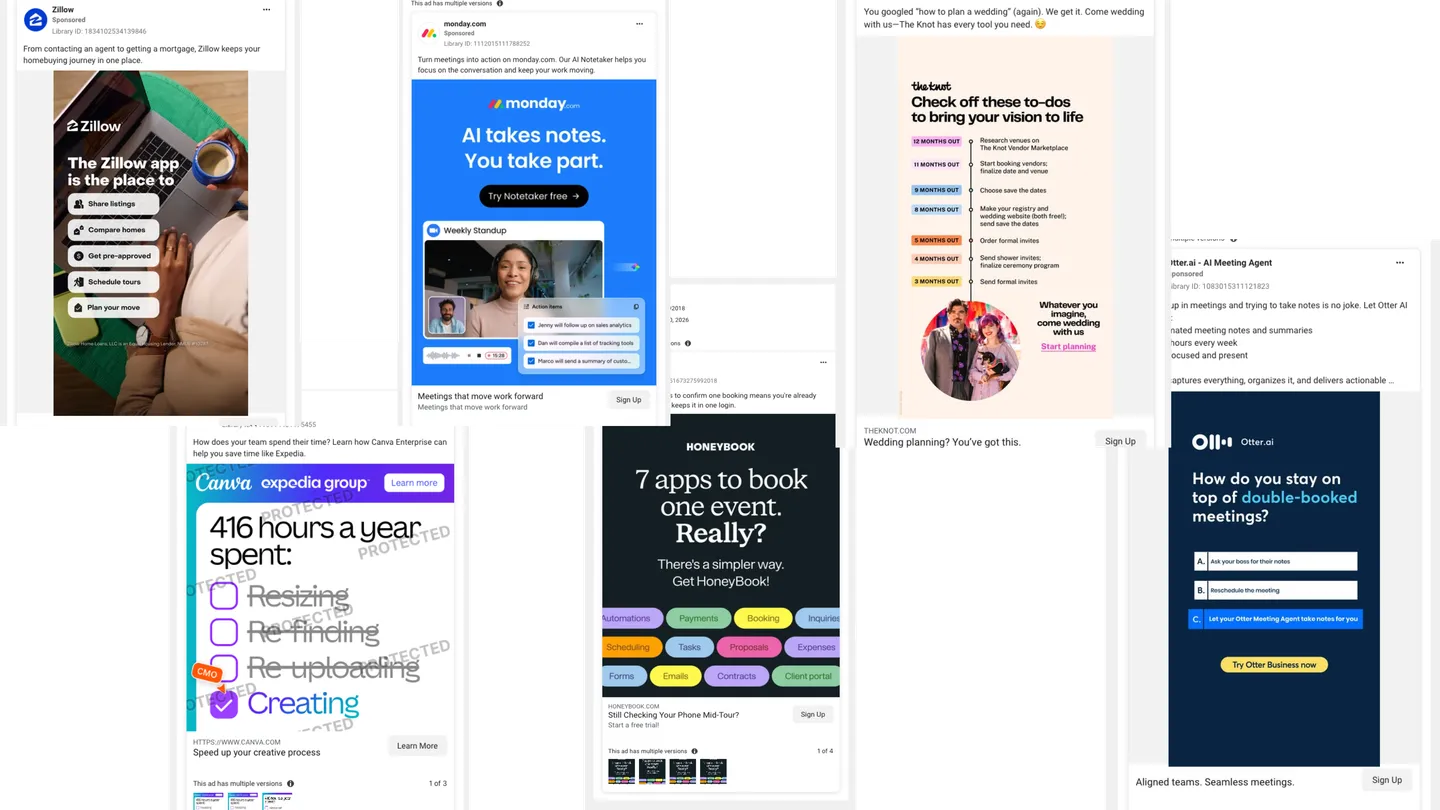
One reference cleared the 30-day line - HoneyBook, at 42 days, and it's the pill-row workflow map: twelve scattered jobs mapped into one visual system. The Knot's timeline infographic and Otter.ai's multiple-choice workflow, both at 24 days, are approaching the line. The pattern across the set: the ads that teach the workflow step by step are the ones holding spend - which is the format bet behind Concepts A, B, and D.
Test concepts
Every concept is written the same way, judged the same way. Primary metric throughout: click-through rate to the planners page, with trial/demo-start conversion as the secondary read.
Control decision: Concept D is the control - it is the strategy made visible. Concept A is the designated first challenger: the strongest single line in the set, held for round two.
Concept D - No templates. Your vision, in 3D. (control)
Format
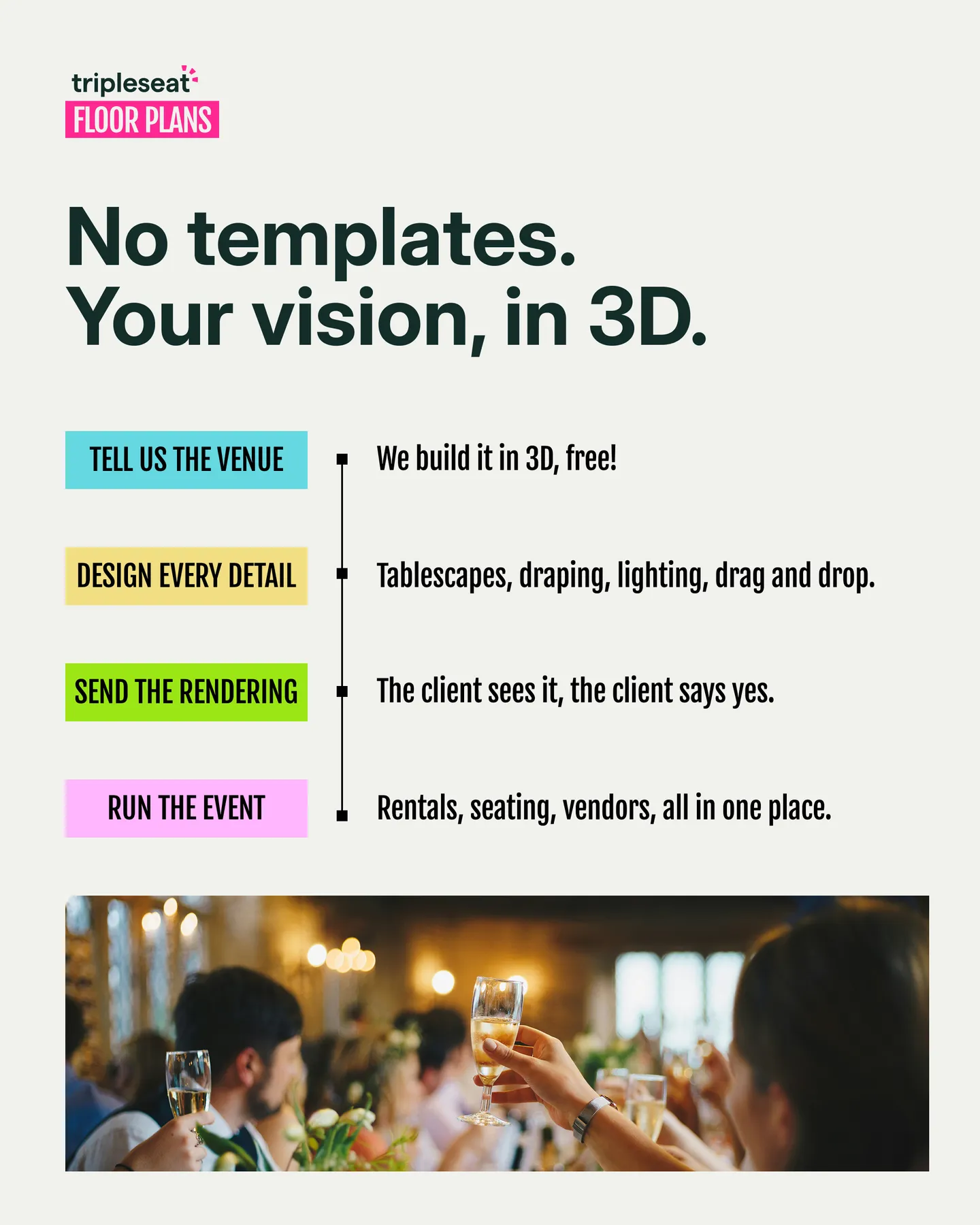
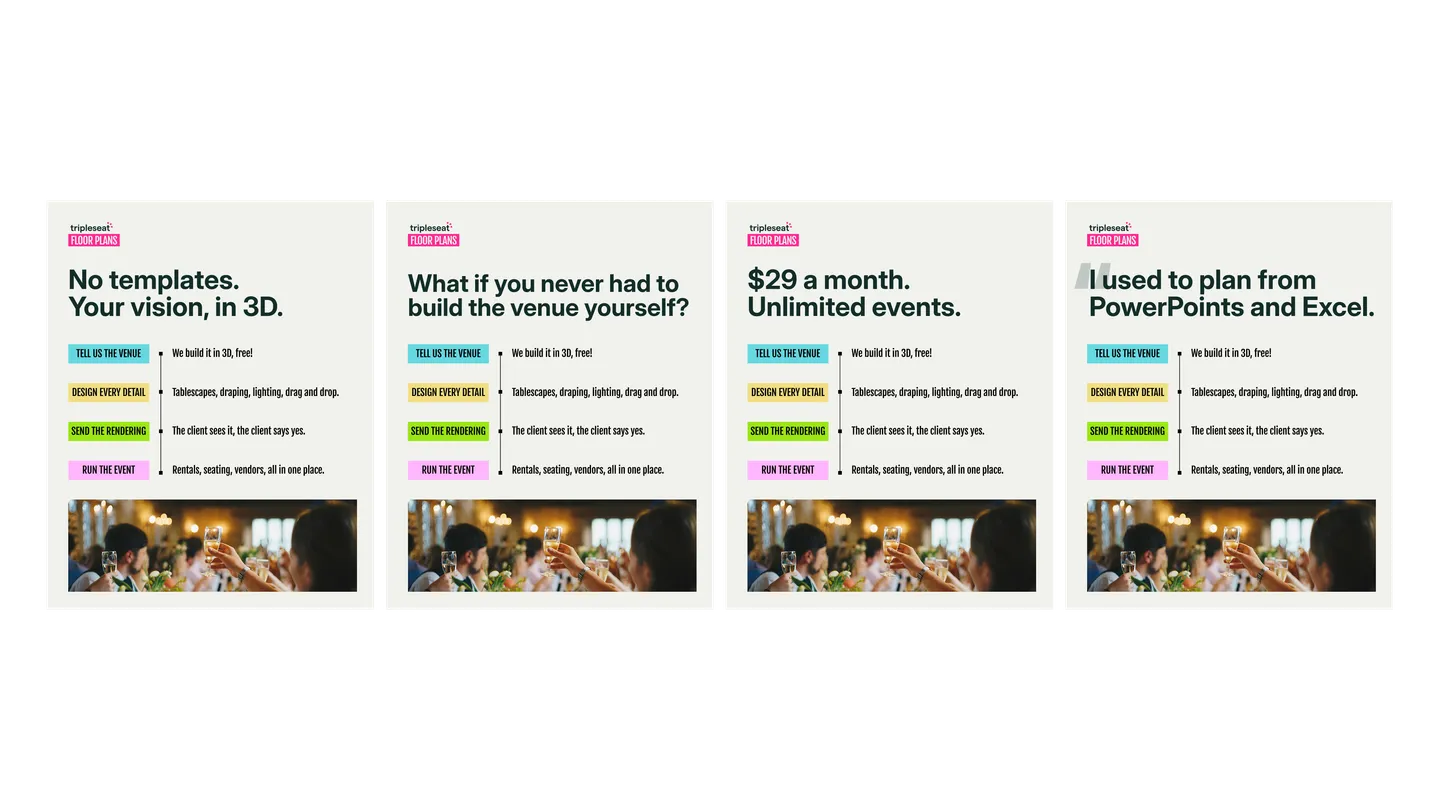
Educational infographic static - color-coded workflow timeline (Tell us the venue / Design every detail / Send the rendering / Run the event), event photo below.
Persona + objection
The Vision Juggler, 21–35, problem-aware - objection 5: “My events are bespoke - a tool will flatten them.”
Awareness level
Problem-aware - she has a working process; the ad teaches where the product slots into it.
Headline
“No templates. Your vision, in 3D.”
Hypothesis
Teaching the workflow step by step beats Concept A's validation-first approach on CTR because it answers the problem-aware planner's real question: where does this live in my week?
Held constant / judge on
Infographic structure, timeline, photo - only the headline moves across the four hook variants below. Judge on: CTR (primary), planners-page conversion (secondary).
Concept D, hook test - one variable, four headline families
The first test built from this study: identical infographic, four headlines, each mapped to one objection. The concept earns the test first - then the hook finds the cheapest way into it.
Hook family
Headline
Objection it answers
Objection (control)
No templates. Your vision, in 3D.
Bespoke work flattened by standardized tools
Question
What if you never had to build the venue yourself?
No time to learn new software - they build it free in 3 business days
Number
$29 a month. Unlimited events.
Another subscription - the tier price, stated flat
Confession
I used to plan from PowerPoints and Excel.
My process already works - voiced in the planner's own past tense
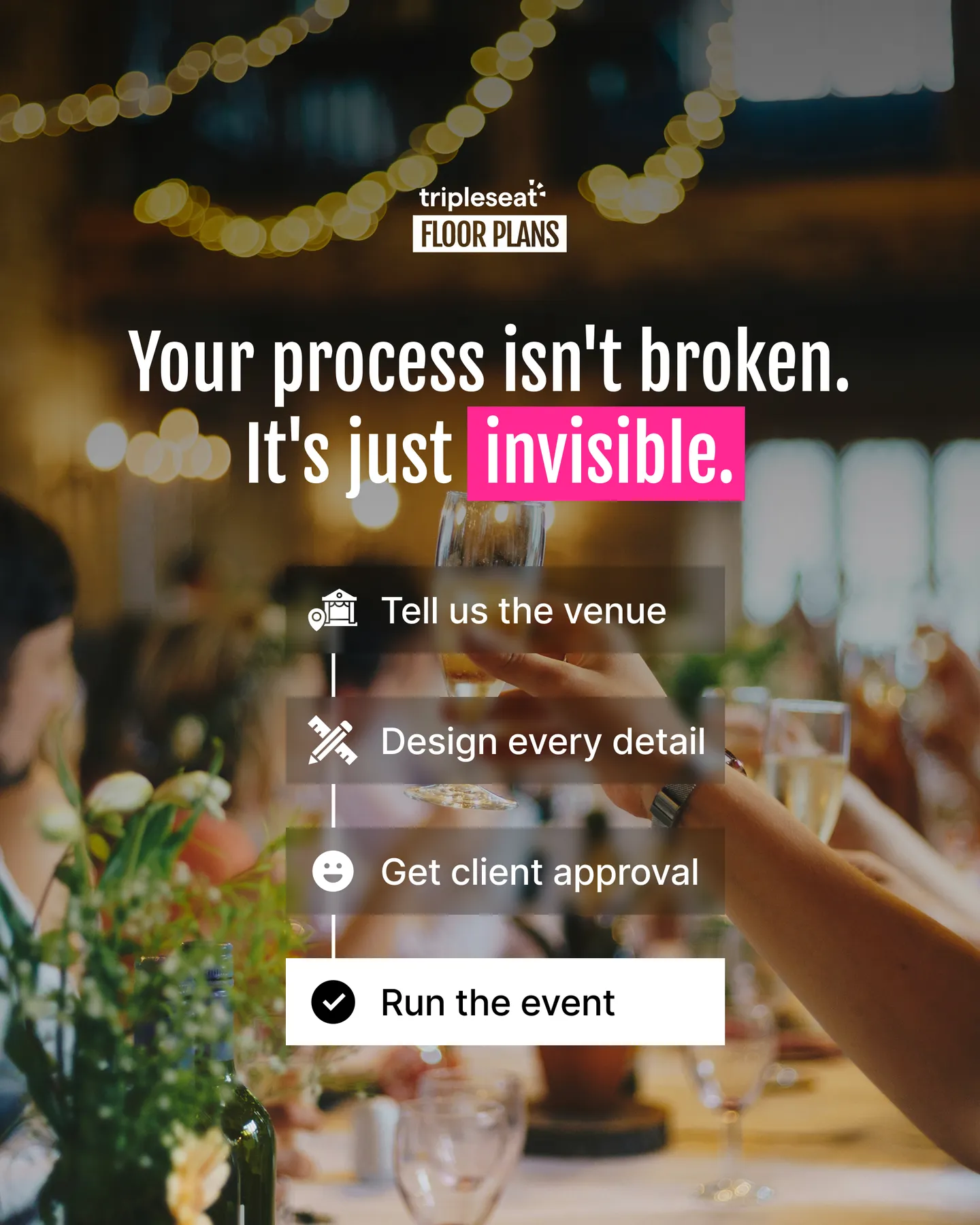
Concept A - Your process isn't broken. It's just invisible. (first challenger)
Format
Headline-led static - event celebration photo, Zillow-style pill workflow (Tell us the venue / Design every detail / Get client approval / Run the event), “invisible” highlighted.
Persona + objection
The Vision Juggler, 21–35, problem-aware - objection 1: “My process already works.”
Awareness level
Problem-aware - validates her process before introducing the product.
Headline
“Your process isn't broken. It's just invisible.”
Hypothesis
Validating the planner's process before naming its invisibility beats Concept D's workflow-first approach on CTR because it disarms the “my process works” objection instead of arguing with it.
Held constant / judge on
Headline, photo, pill workflow. Judge on: CTR (primary). Tests against the Concept D control in round two.
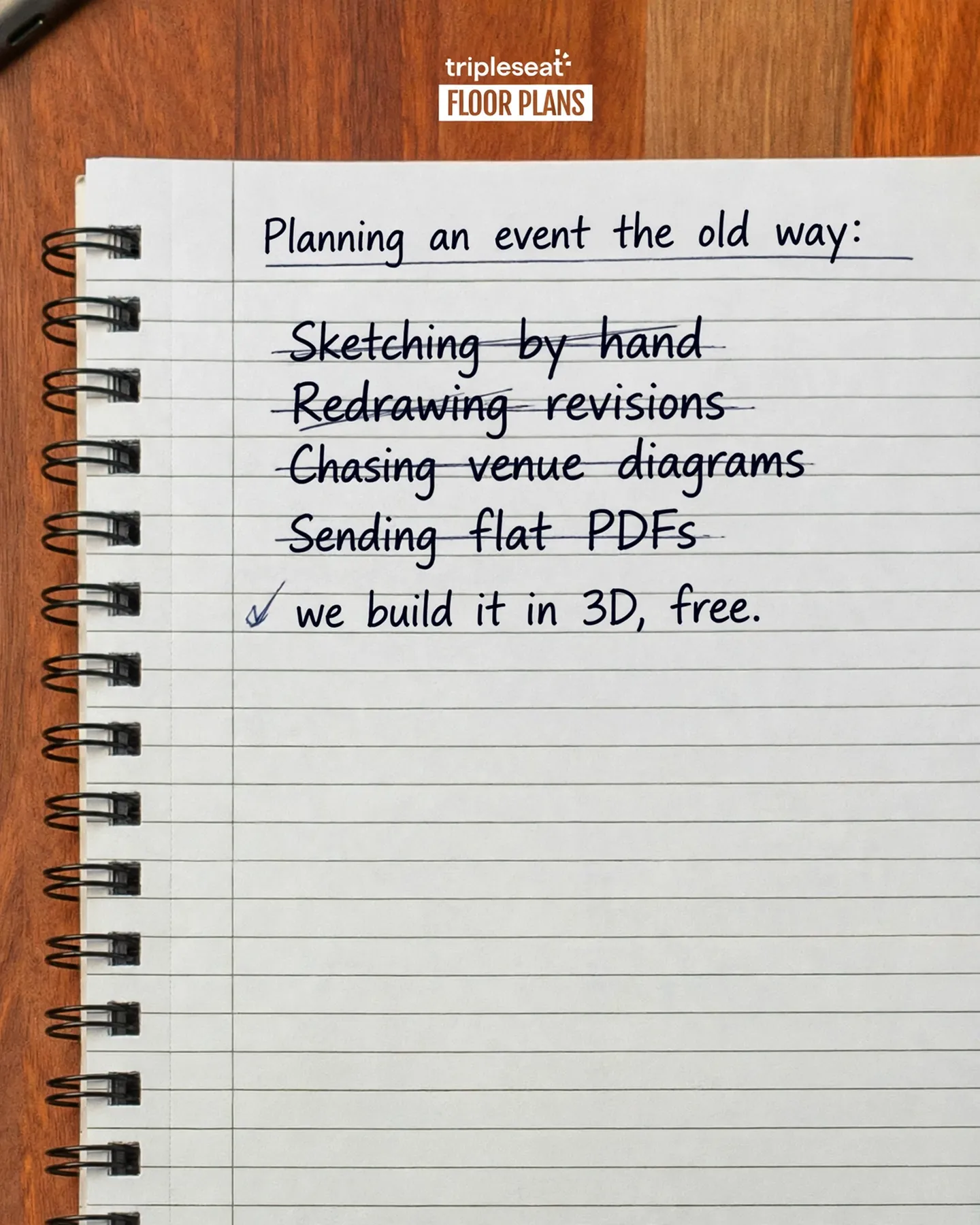
Concept B - Planning an event the old way (novelty concept)
Format
Handwritten notebook static - Canva-style strikethrough list of manual steps, final line checked: “we build it in 3D, free.”
Persona + objection
The Vision Juggler, 21–35, problem-aware - objection 2: “I don't have time to learn new software.”
Awareness level
Problem-aware - the manual past is the entry point.
Headline
“Planning an event the old way:” (title); the checked line carries the product promise.
Hypothesis
A handwritten strikethrough list of the manual past stops the scroll more cheaply than any benefit headline because the planner recognizes her own Tuesday in it.
Held constant / judge on
Notebook frame, struck list, checked line. Judge on: CTR (primary), with a save/share read as the qualitative signal.
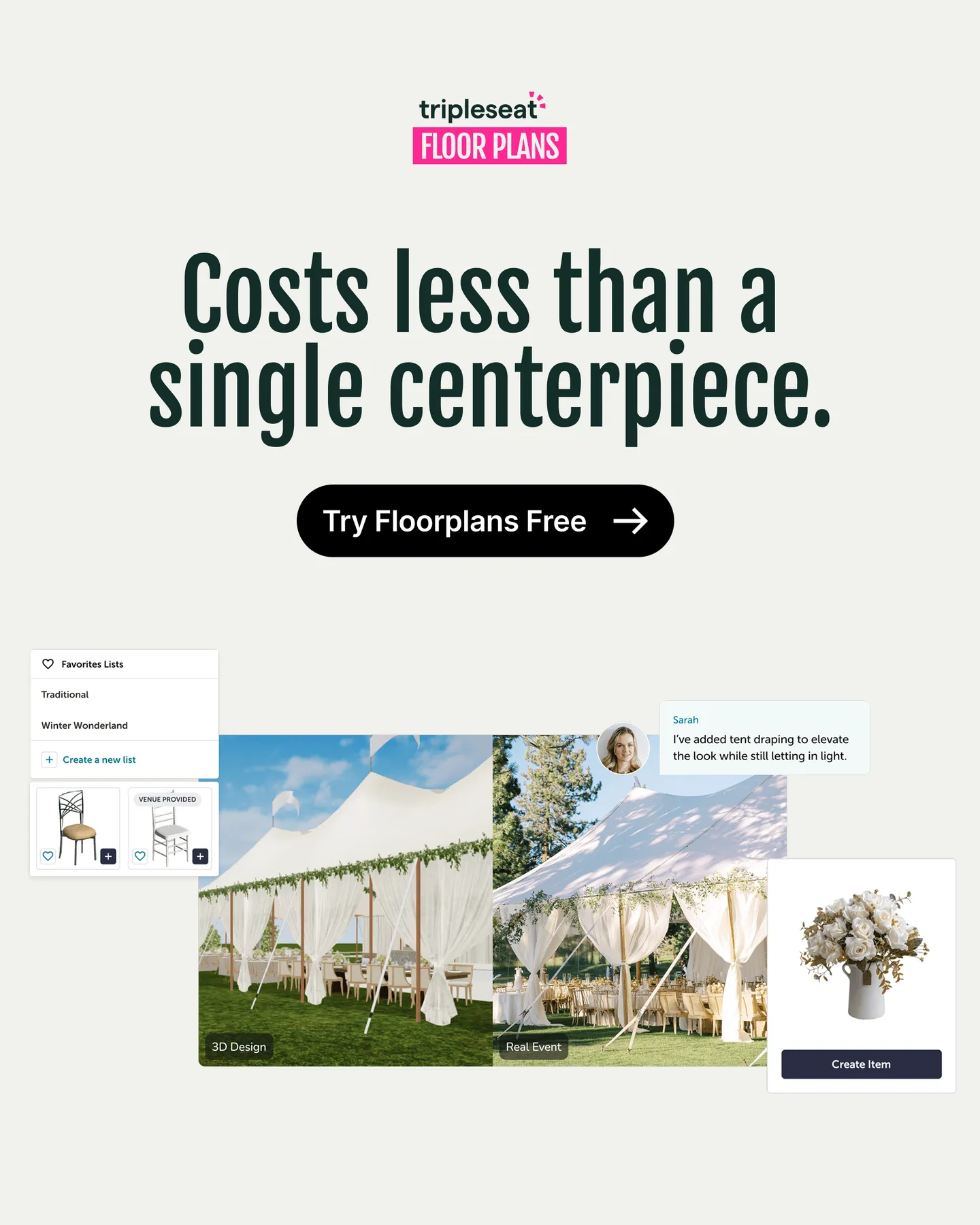
Concept C - Costs less than a single centerpiece. (price concept)
Format
Price-led static - headline, “Try Floorplans Free” CTA button, product UI collage (3D Design vs Real Event, favorites lists, testimonial chip, centerpiece card).
Persona + objection
The Vision Juggler, 21–35, problem-aware - objection 3: “Another subscription?”
Awareness level
Problem-aware to solution-aware - the dollar is the barrier, not the category.
Headline
“Costs less than a single centerpiece.”
Hypothesis
Pricing the product against a line item the planner already buys (a centerpiece) beats the Concept D control on CTR because it reframes $29/month from “another subscription” to “cheaper than decor.”
Held constant / judge on
Headline, CTA, UI collage. Judge on: CTR (primary), trial-start conversion (secondary - the CTA promises “free”).
Held for a later round: the accuracy objection (“Will the render match the real room?” → “Your venue, recreated to the inch.”). It sits out this test so the read stays clean; it becomes a challenger once the Concept D vs. Concept A question is answered.
Test plan
The sequence: concept first, then hook, then format. A hook tested on a weak concept wastes spend; a format tested before the hook is known confuses the read.
Round
Question
What moves
1. Concept
Which structure teaches the workflow?
Concept D (control) vs. Concept A (challenger); B and C held as novelty/price challengers
2. Hook
Which objection is the live blocker?
Headline only - objection, question, number, confession (the four D variants)
3. Format
What carries the winner furthest?
Infographic density, timeline vs. pill workflow, photo vs. UI collage
Cadence
One round at a time, no edits mid-round, reads taken on full calendar days, and the kill/scale thresholds for the round written down before spend starts.
How winners become the new control
A variant that is sufficiently tested and wins is promoted to control; the next round tests against it, and the beaten control is retired to the swipe file with its numbers attached.
What feeds round three
Inside the winning headline, the infographic cells become the variable - which workflow step leads, timeline versus pill structure, and whether the event photo or the product UI earns the bottom slot.
Sources
Next
Persona