Persona
From another gadget to charge to a wearable that pays for itself
Brand snapshot
Persona sells Persona Band, a light, screen-light wearable sold at yourpersona.com/band. The job it performs is errand completion with proof: in the brand's own language it “makes the calls, books the appointments, cancels the subscriptions and comes back with confirmations,” and every task “comes back with its receipts.” The wearable is the delivery surface; the product is time and money handed back.
The offer
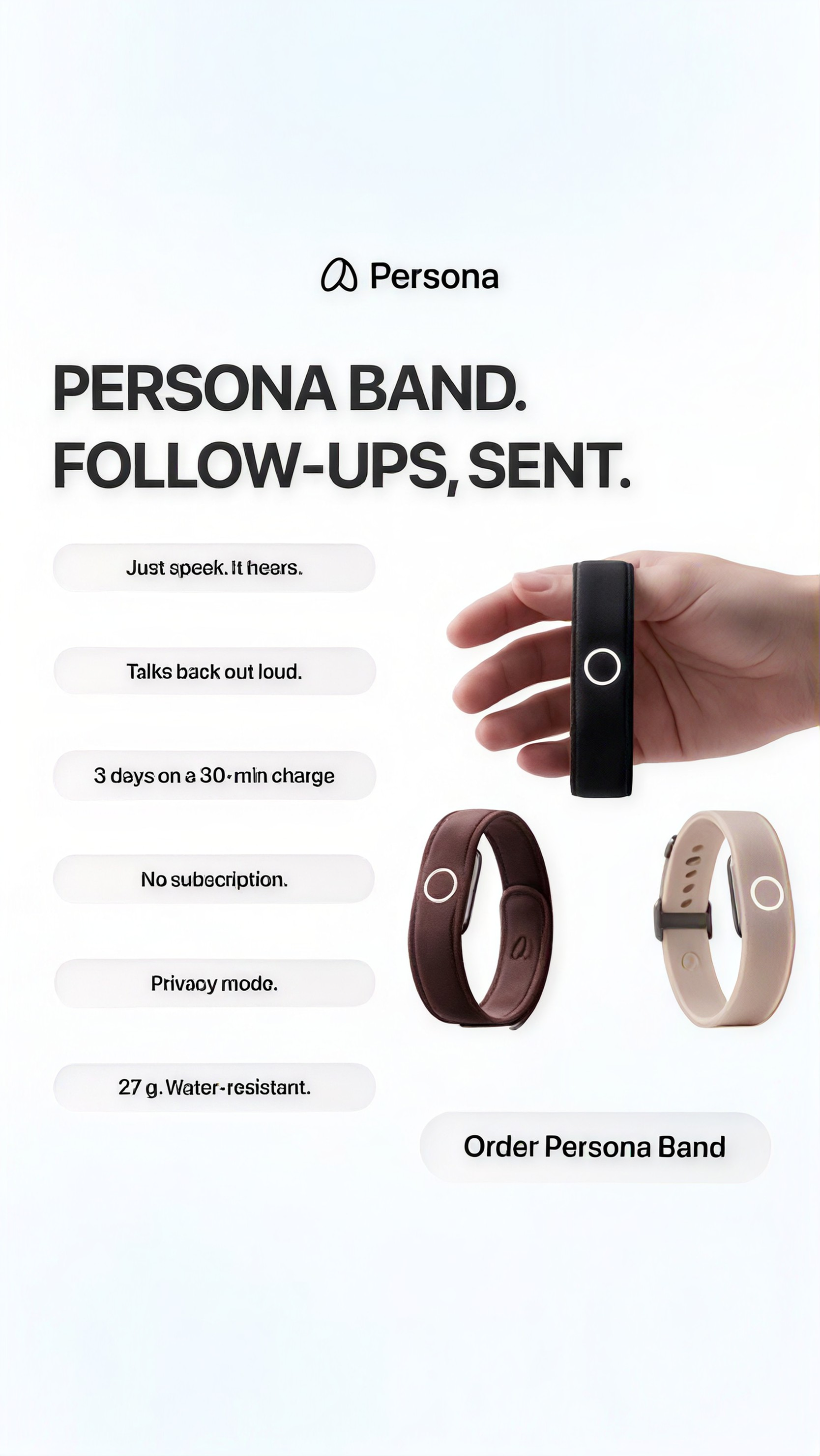
A band (27 g, water-resistant, “3 days on a 30-min charge” in current ad copy) that takes instructions and returns confirmations in a message thread the user already lives in.
Who buys it
Busy, phone-fatigued professionals who already pay for help in fragments - assistants, subscription sprawl, travel rebooking - and who resist adding another app, feed, or device to maintain.
Price/objection shape
“No subscription” appears in current copy, but as a pricing fact, not as a benefit of wearing the band itself. The live objections are charging burden, feed fatigue, and whether the band earns wrist space at all.
The control
“PERSONA BAND. FOLLOW-UPS, SENT.” (Library ID 1416447749922990) - the existing ad this study tests against. Band product shot with feature pills (3 days on a 30-min charge, no subscription, 27 g water-resistant); post copy “Meet Persona Band, the first AI assistant you can wear.”
Diagnosis
The account is not broken. It is narrow: one awareness level, one proof type, and no objection spoken out loud. Each lens names a gap a test can close.
Lens 1Awareness levels covered vs. missing
Awareness level
Covered today?
What is missing
Unaware
No
No entry creative naming the hidden cost of subscription sprawl
Problem-aware
Partial
Money-waste pain named in variants (“$1,344 a year, hiding in your subscriptions”) but never as the control
Solution-aware
Yes
Done-list errands assume the reader already wants an assistant
Product-aware
Yes
Band hardware claims speak to people already comparing wearables
Most-aware
No
No receipts-led closer, no control built for retargeting
Synthesis
The ads speak to people who already accept the category. The larger pool - people who know they waste money and time but have not chosen a wearable assistant - is never addressed in its own language.
Lens 2Formats used vs. unused
Used
Benefits-callout statics - the account's home format, ~83 statics at capture: “DO NOTHING get it all done,” “PERSONA BAND. FOLLOW-UPS, SENT.,” “NEVER CALL AGAIN,” “Say the task. Get the receipt.” Every one of them sells time.
Also used, as a variant
Money-led callouts - “$1,344 a year, hiding in your subscriptions. Get it back.” Money exists in the account, but as one angle among time-led creative, never as the control the account is built around.
Unused
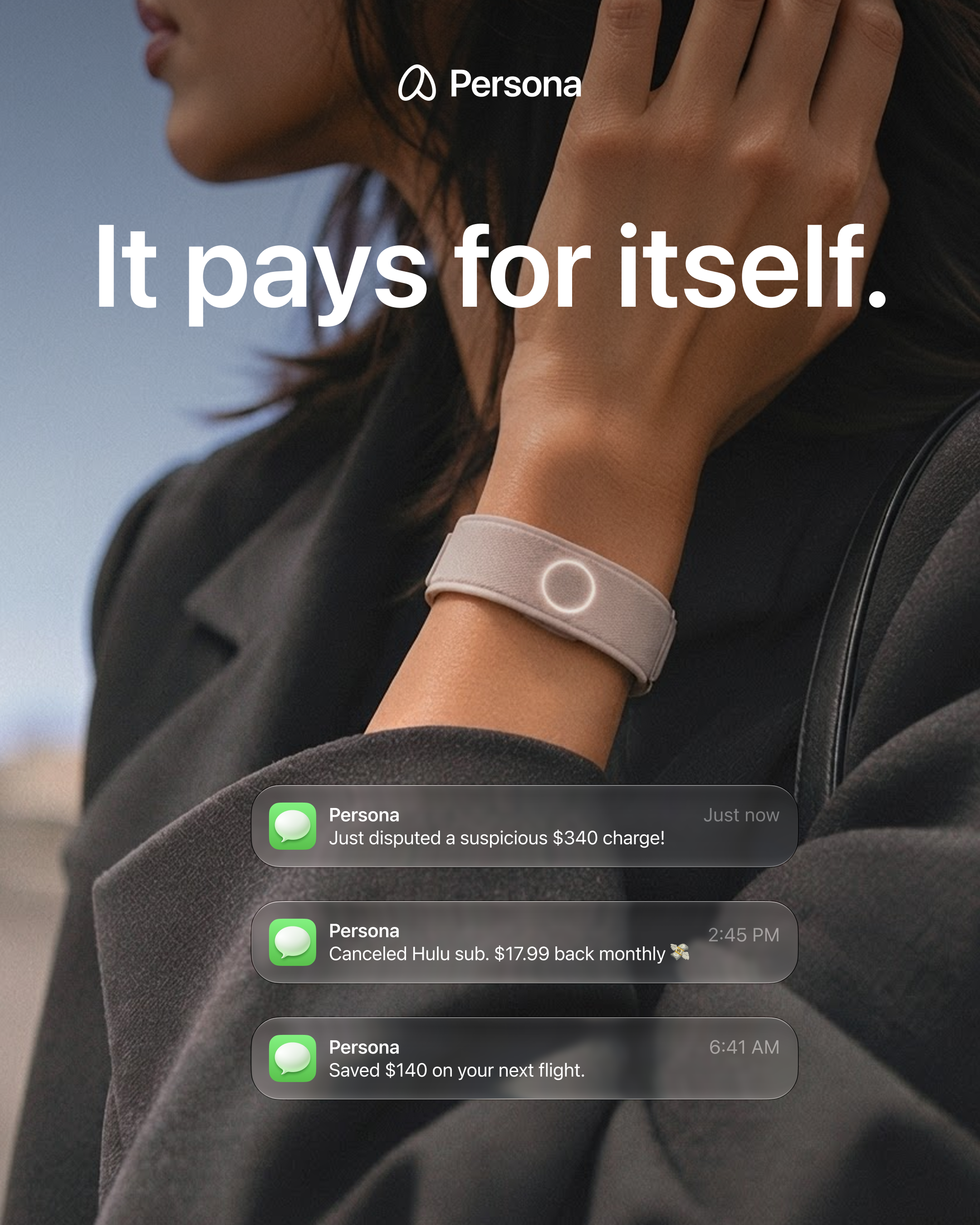
Money as the control - receipt-specific, named-amount proof (“Disputed a $340 charge,” “Canceled the gym”) leading the creative, instead of aggregate annual estimates inside a time-led account.
Lens 3Positioning said out loud vs. left in the deck
Said out loud
Errands get done; no subscription; battery and weight.
Said in a variant
“$1,344 a year, hiding in your subscriptions. Get it back.” - money as an angle, tested.
Left as the lead story
The band pays for itself. Persona's own capabilities - disputing charges, catching renewals before they bill, flagging double charges, rebooking cheaper - add up to a money-back story that appears in one variant's headline, never as the control. A pricing fact (“No subscription”) is doing duty as a benefit elsewhere, and it is not one: it says what the band does not cost, not what it earns.
Also left unsaid
“No feed to feed.” The product's screen-light, no-app nature is a positioning weapon against feed fatigue, and no current ad names that fear.
Lens 4Customer language mined vs. generic
The done-list is the strongest language asset in the account: specific, past-tense, receipt-shaped (“Disputed a $340 charge”). The generic failure mode is category verbs - “manages your subscriptions,” “handles your bookings” - which describe a capability and prove nothing. Every concept below keeps the receipt voice and pushes specificity further: a named charge, a named dollar amount, a named moment (“before it billed”).
Language bank - mined verbatim from Persona's live ads, sorted by what each line proves:
Line (verbatim)
Proves
Disputed a $340 charge
Money - receipt-specific
Canceled the gym
Money - receipt-specific
$1,344 a year, hiding in your subscriptions. Get it back.
Money - aggregate
Say the task. Get the receipt.
Money - receipt promise
You didn't need to do anything. Here are the receipts.
Money - receipt promise
Replies sent
Errand
Flights booked
Errand
Rescheduled the plumber
Errand
Booked a table for two
Errand
Recognize this pile? Persona cleared it. Every single one.
Errand - pain-led
DO NOTHING get it all done.
Time - lead benefit
PERSONA BAND. FOLLOW-UPS, SENT.
Time - lead benefit
NEVER CALL AGAIN.
Time - lead benefit
You're not lazy, it's just the 14th thing on today's list.
Time - reframe
You can now stop being the family's to-do list
Time - reframe
Two mics that hear a whisper…
Hardware
3 days on a 30-min charge / 27 g. Water-resistant.
Hardware
No subscription.
Pricing fact (not a benefit)
Category proof
A competitor ad its advertiser keeps funding past one full test cycle is a spend signal. Meta's own A/B guidance caps a test at 30 days - so 30+ days live means the ad survived at least one read and kept its budget. That is the threshold used here, and the reason for it. One caution: a long run means sustained spend, not proven performance - the library shows dates, not results.
Pattern to verify - longevity
Which competitor ads in the wearable-assistant and subscription-savings space have run 30+ days, and what single proof each one leads with.
Pattern to verify - format reward
Whether the surviving ads are objection-led, receipt-led, or hardware-led, and which format (static benefits-callout, message thread, annotated breakdown) keeps its budget longest.
Position to take
If the surviving money ads lead with a specific recovered amount and the surviving wearable ads lead with hardware, Persona's untested middle - money proof on a wrist - is the open lane.
Longevity at capture, against the 30-day line:
Competitor
Library ID
Start date
Days live at capture
Granola
1740056957277376
Sep 17, 2026
23
Noom
1582597313169244
Sep 11, 2026
29
Oura
1750992419569930
Sep 21, 2026
19
Hims
1805526277137852
Sep 23, 2026
17
Rocket Money
1719128725841091
Oct 5, 2026
5
Motion
1412713087007135
Feb 18, 2026
35 (ended Mar 23)
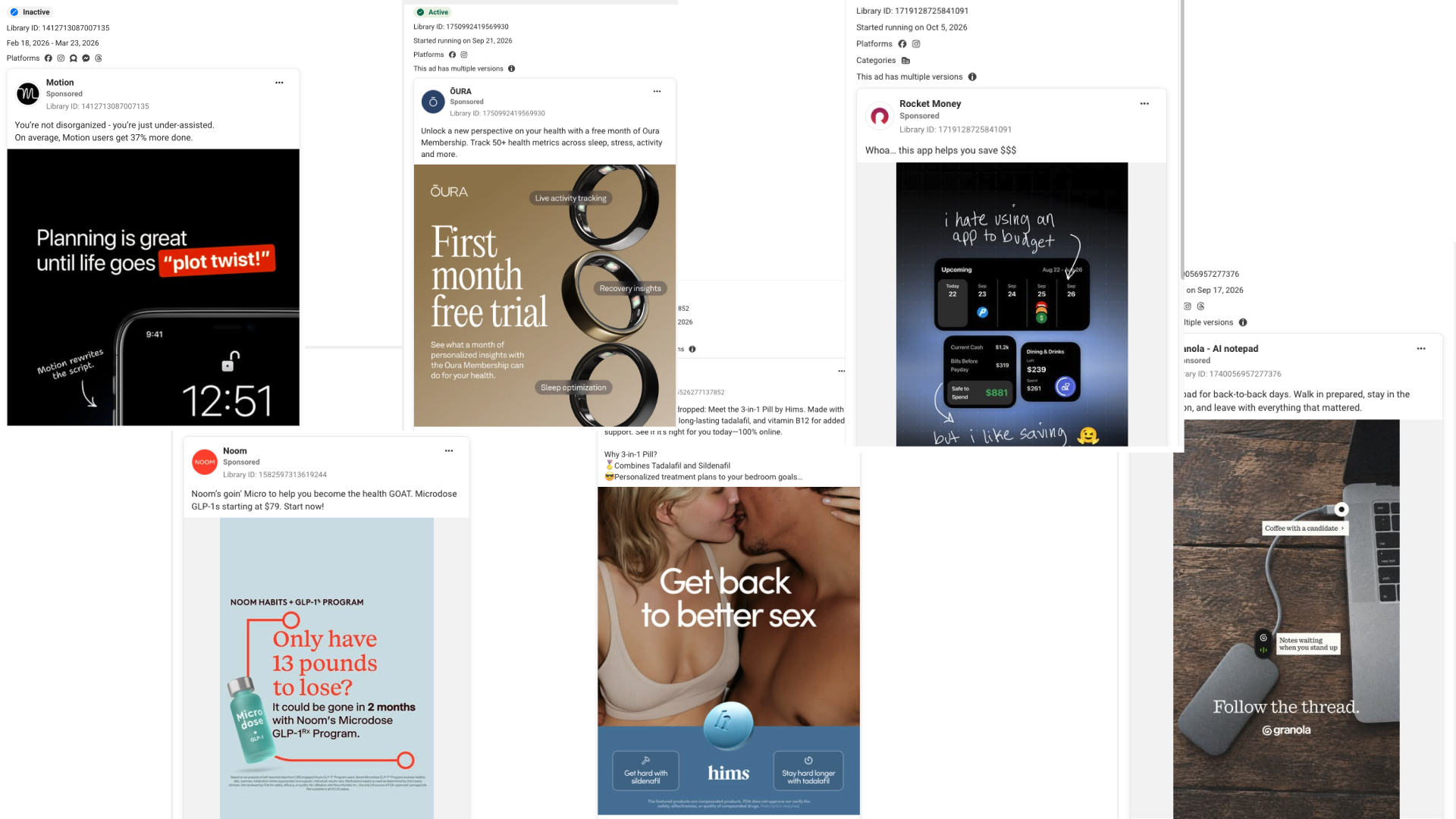
None of these is a proven 30-day survivor still running. What the set does show is program discipline - multi-version flags, deliberate dated batches like Rocket Money's 14-ad October 5 launch - and every one of those programs chose the same shape: one static, one promise.
Test concepts
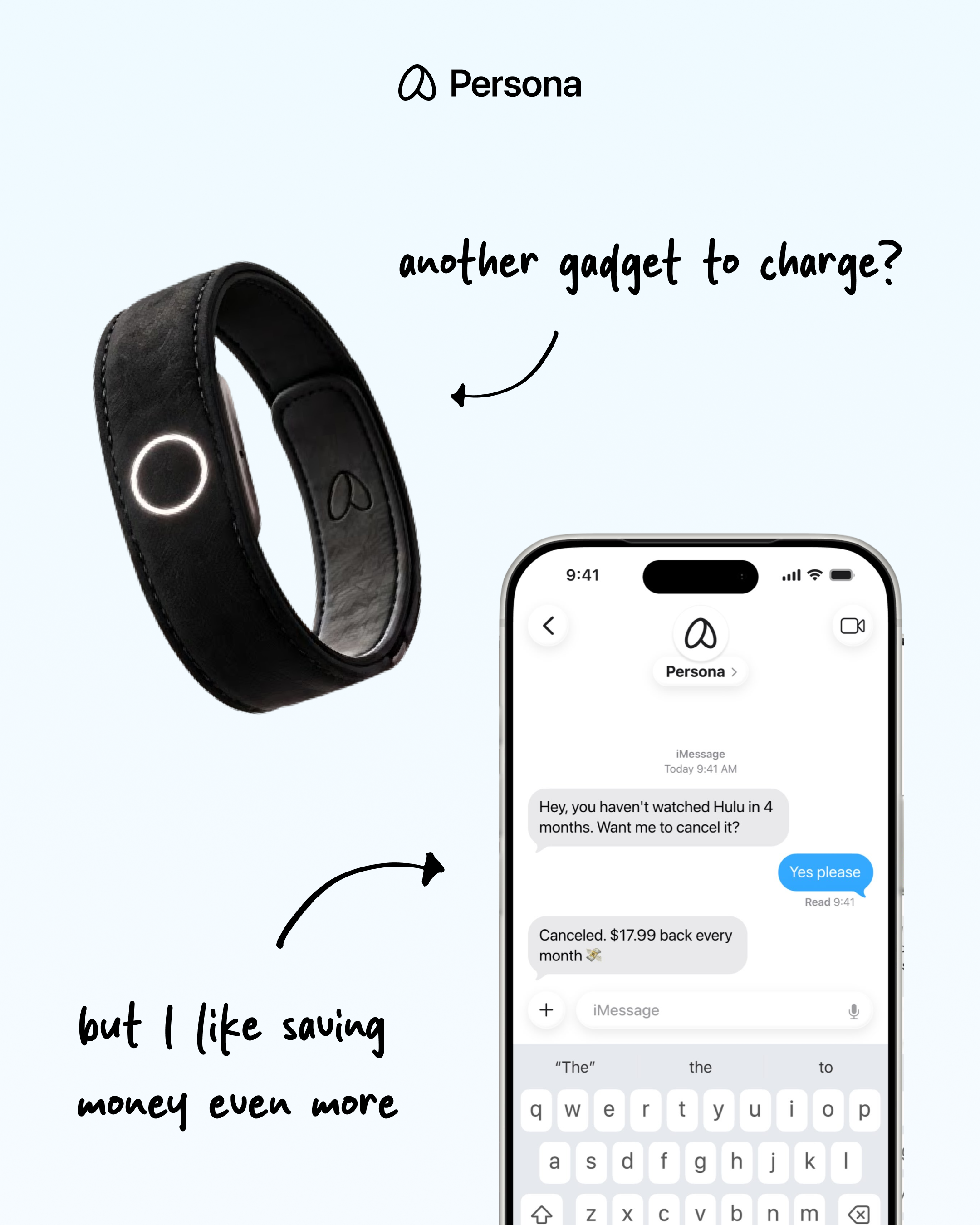
Concept 1 - Another gadget to charge?
Format
Static, objection-then-flip - headline objection on top, iMessage-style receipt thread as the proof below.
Persona + objection
Wearable-skeptic professional: “I already charge a phone and a watch; I am not maintaining another device.”
Awareness level
Problem-aware - knows gadget fatigue, has not connected it to a money fix.
Headline
“Another gadget to charge?” - answered in frame by the money receipts beneath it.
Hypothesis
Naming the charging objection in the headline and answering it with money receipts in the same frame beats the current control on CTR.
Held constant / judge on
Band photo, receipt thread, layout. Judge on: CTR (primary), page conversion (secondary). Kill/scale: 0.7× / 1.3× control CTR after 100 link clicks per variant.
Concept 2 - The wearable that earns its wrist
Format
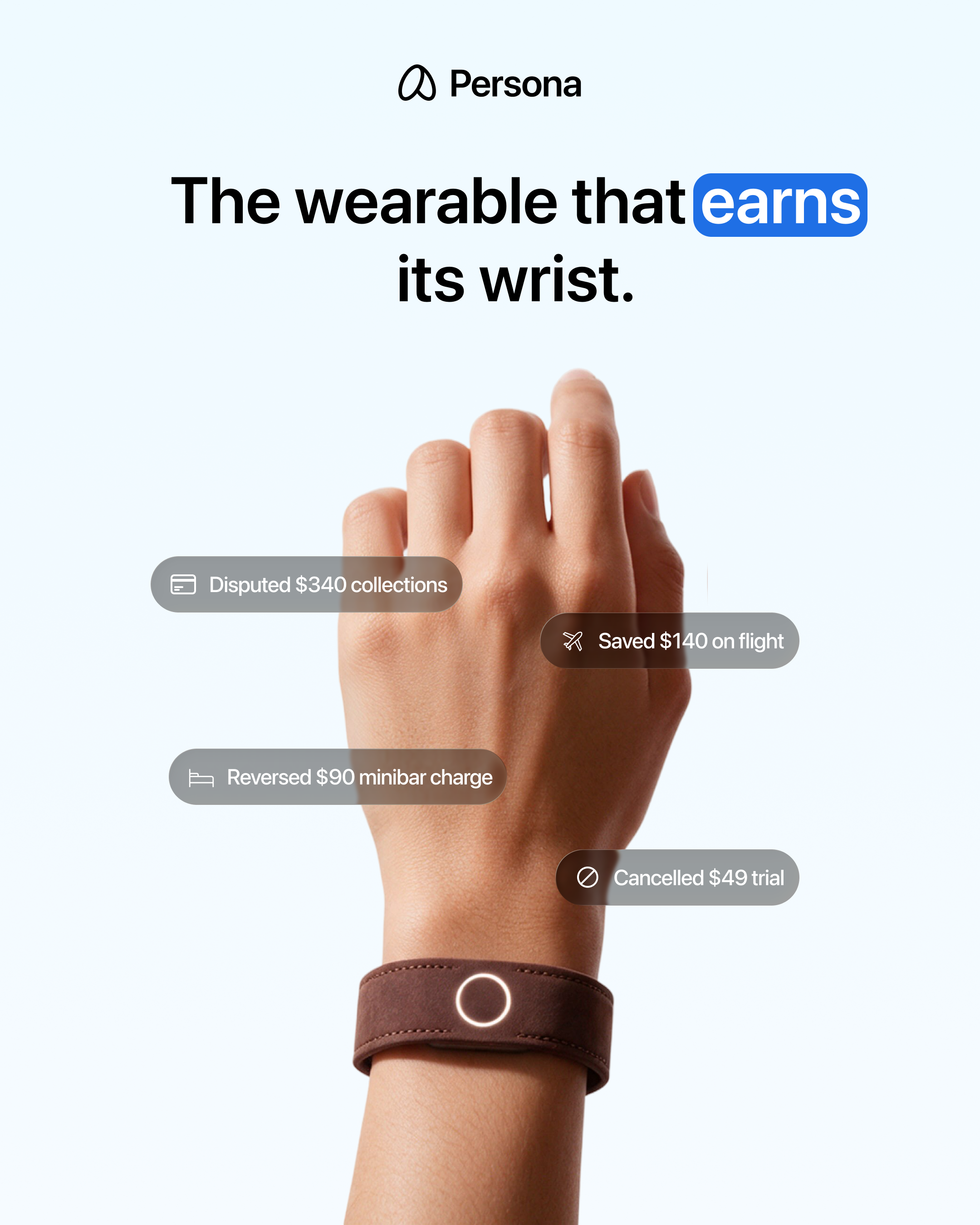
Static, band-hero with four specific money-proof chips flanking the product.
Persona + objection
Wrist-space gatekeeper: “Something lives on my wrist only if it earns its place every day.”
Awareness level
Solution-aware - comparing what a wearable must do to deserve the wrist.
Headline
“The wearable that earns its wrist.”
Hypothesis
Four specific, differently-flavoured money proofs (a reversed charge, a lowered bill, a killed trial, a cheaper rebooking) beat generic capability claims on CTR because each chip gives a different viewer a way in.
Held constant / judge on
Headline, band photo, layout. The four chips are the test surface in round two (see Test plan). Judge on: CTR (primary). Kill/scale: 0.7× / 1.3× control CTR after 100 link clicks per variant.
Concept 3 - It pays for itself
Format
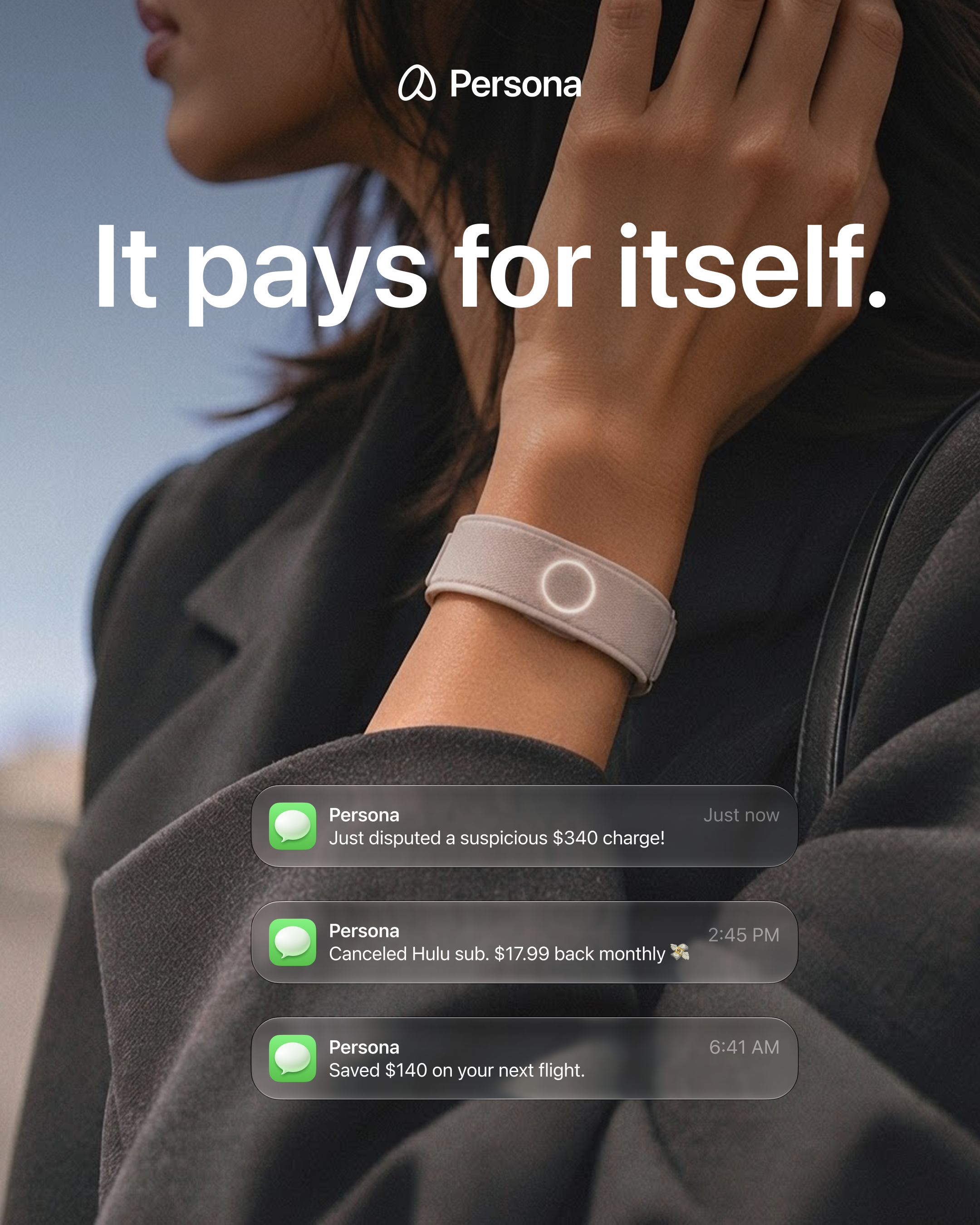
Static, money-headline hero - the selected lead concept; four receipts on the creative, headline is the only variable across its test set.
Persona + objection
Value-first skeptic: “Show me it pays for itself and I will listen; sell me features and I will scroll.”
Awareness level
Problem-aware to solution-aware - the money-waste pain is the entry point.
Headline
“It pays for itself.”
Hypothesis
A direct money headline that decodes in under a second beats clever framing on CTR for a problem-aware audience - and receipt-specific proof (“Disputed a $340 charge”) beats their in-account aggregate money variant (“$1,344 a year”) because a named receipt is verifiable in a way an annual estimate isn't.
Held constant / judge on
Image, four receipts, layout - only the headline moves (Question / Number / Confession / Objection, below). Judge on: CTR (primary). Kill/scale: losing headlines cut at 0.7× the set leader after 100 link clicks each.
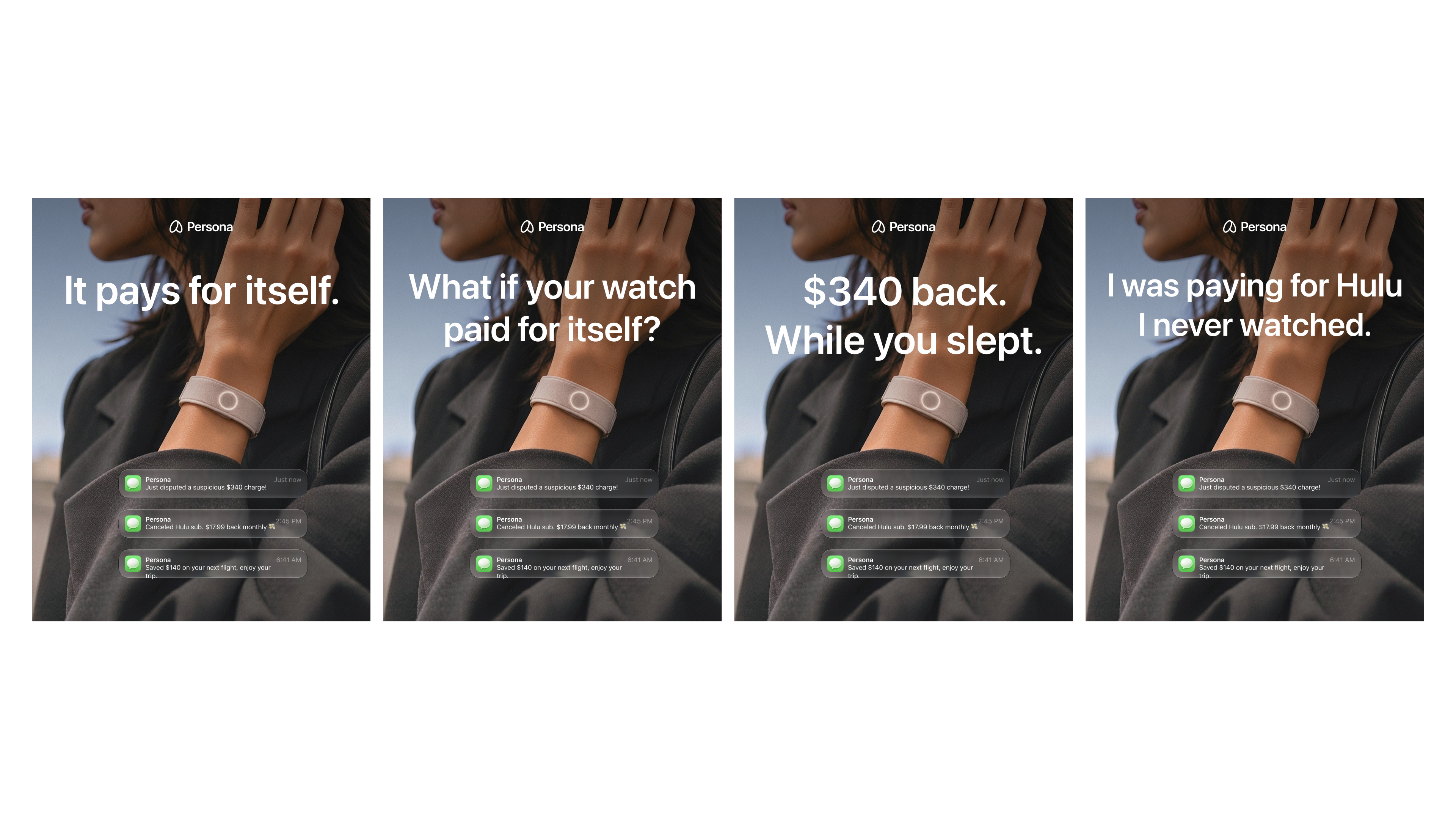
Concept 3, hook test - one variable, four headline families
The first test built from this study: identical creative, four headlines. The concept earns the test first - then the hook finds the cheapest way into it.
Hook family
Headline
Why it should work
Claim
It pays for itself.
Desire stated flat; zero decoding for a problem-aware reader
Question
What if your watch paid for itself?
A question the brain answers before it decides to care
Number
$340 back. While you slept.
Largest proof already in the creative becomes the headline
Confession
I was paying for Hulu I never watched.
First-person guilt reads as a person, not a brand
Objection
Another gadget to charge?
Names the barrier, filters spend toward skeptics
Concept 4 - Your data stays yours
Format
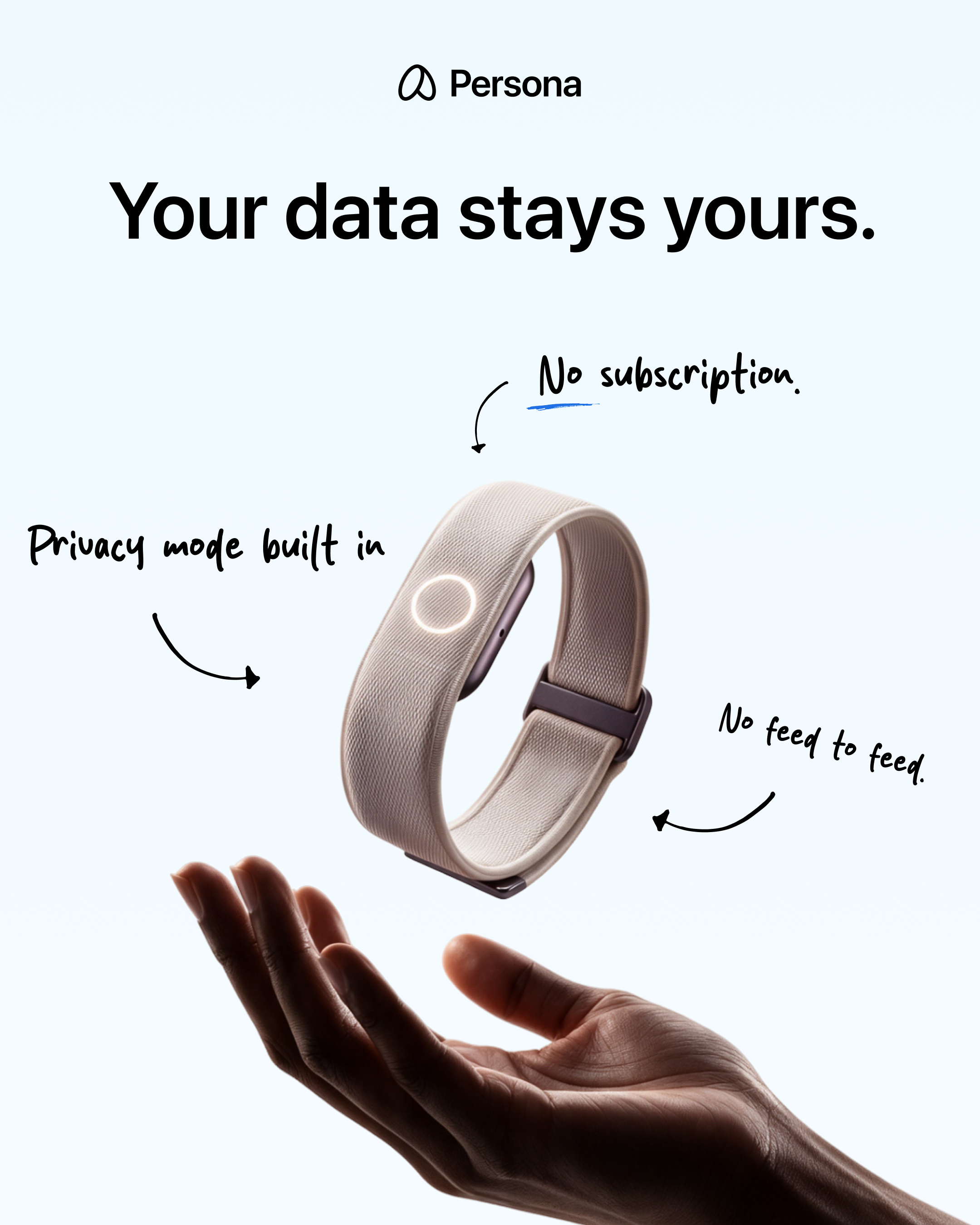
Static, quiet band shot with handwritten-style annotations on the receipt thread.
Persona + objection
Privacy-guarded buyer: “I will not hand my calendar, inbox, and cards to something that talks about me.”
Awareness level
Problem-aware - the pain is trust, not money; money receipts are the surprise proof.
Headline
“Your data stays yours.”
Hypothesis
Naming the privacy fear in four words stops the scroll more cheaply than any benefit headline for the trust-pained segment.
Held constant / judge on
Band photo, annotated receipt thread. Judge on: CTR (primary), with a save/share read as the qualitative signal. Kill/scale: 0.7× / 1.3× control CTR after 100 link clicks.
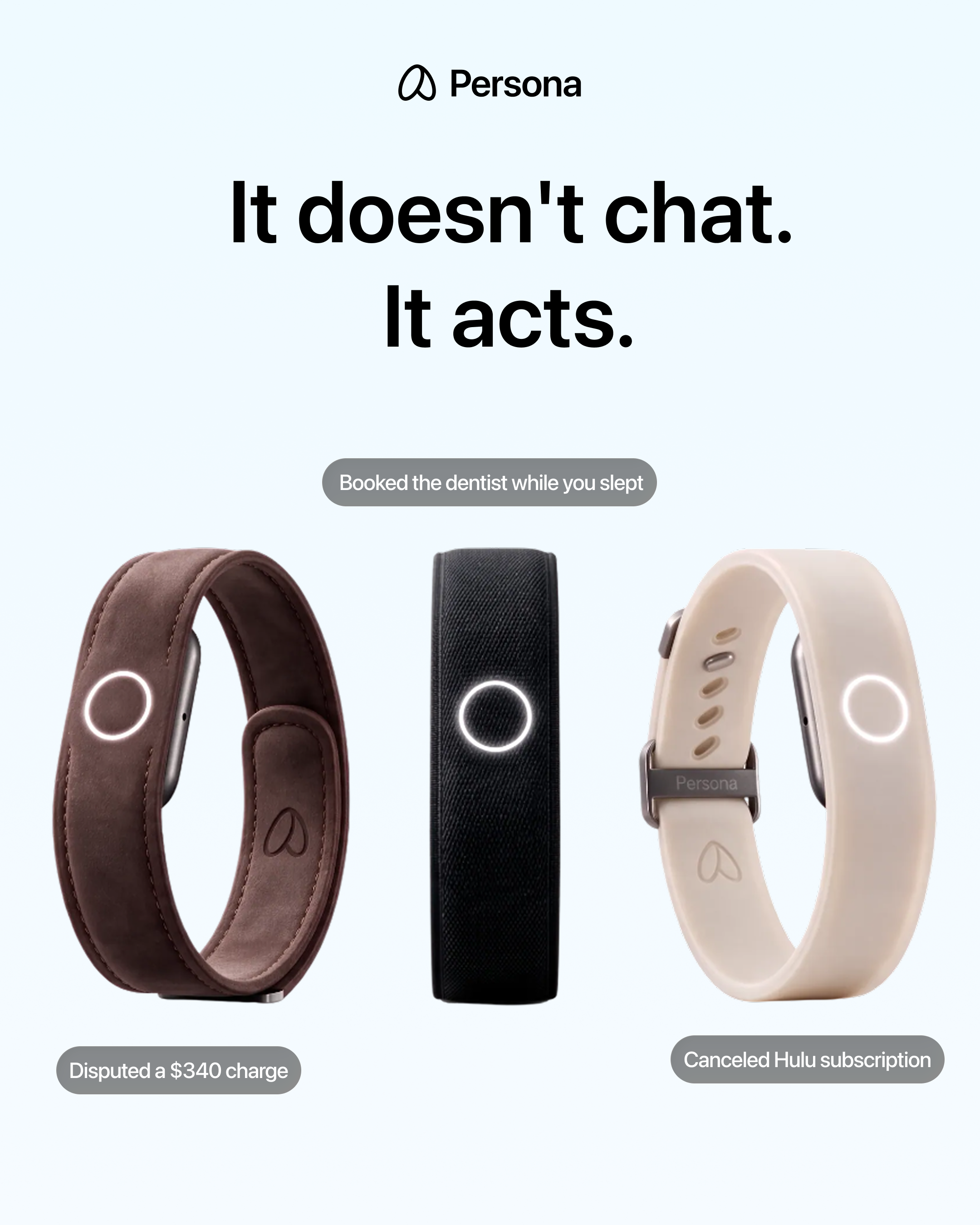
Concept 5 - It doesn't chat. It acts.
Format
Action-led static - the band shown doing the work (calls made, appointments booked, charges disputed), no chat thread to manage.
Persona + objection
Back-and-forth skeptic: “I don't want another chatbot to babysit; tell it once and have it handled.”
Awareness level
Product-aware - closest to buying; needs evidence of action, not another conversation demo.
Headline
“It doesn't chat. It acts.”
Hypothesis
Showing finished jobs instead of a conversation beats chat-led framing on CTR because the promise is done work, not a dialogue - the band watches out for you and acts without the back-and-forth.
Held constant / judge on
Band photo, action proof, layout. Judge on: CTR (primary), page conversion (secondary). Kill/scale: 0.7× / 1.3× control CTR after 100 link clicks per variant.
Test plan
The sequence: concept first, then hook, then format. A hook tested on a weak concept wastes spend; a format tested before the hook is known confuses the read.
Round
Question
What moves
1. Concept
Which objection is worth money?
Concept 1–5 vs. current control, one at a time
2. Hook
Cheapest way into the winning concept?
Headline only - claim, question, number, confession, objection
3. Format
What carries the winner furthest?
Static vs. message-thread vs. annotated breakdown
Each round's winner becomes the next round's control. The account compounds instead of restarting.
Cadence
One round at a time, 100 link clicks per variant before any kill call, reads taken on calendar days not partial days, no edits mid-round.
How winners become the new control
A variant that clears 1.3× the control's CTR across two consecutive days is promoted to control; the next round tests against it, and the beaten control is retired to the swipe file with its numbers attached.
What feeds round two
Inside the winning concept, the proof chips become the variable - which specific recovered amount, which order, money proof versus errand proof in the fourth slot.
Sources
Next
Jukebox