Jukebox
Not another natural soap to try.
Brand snapshot
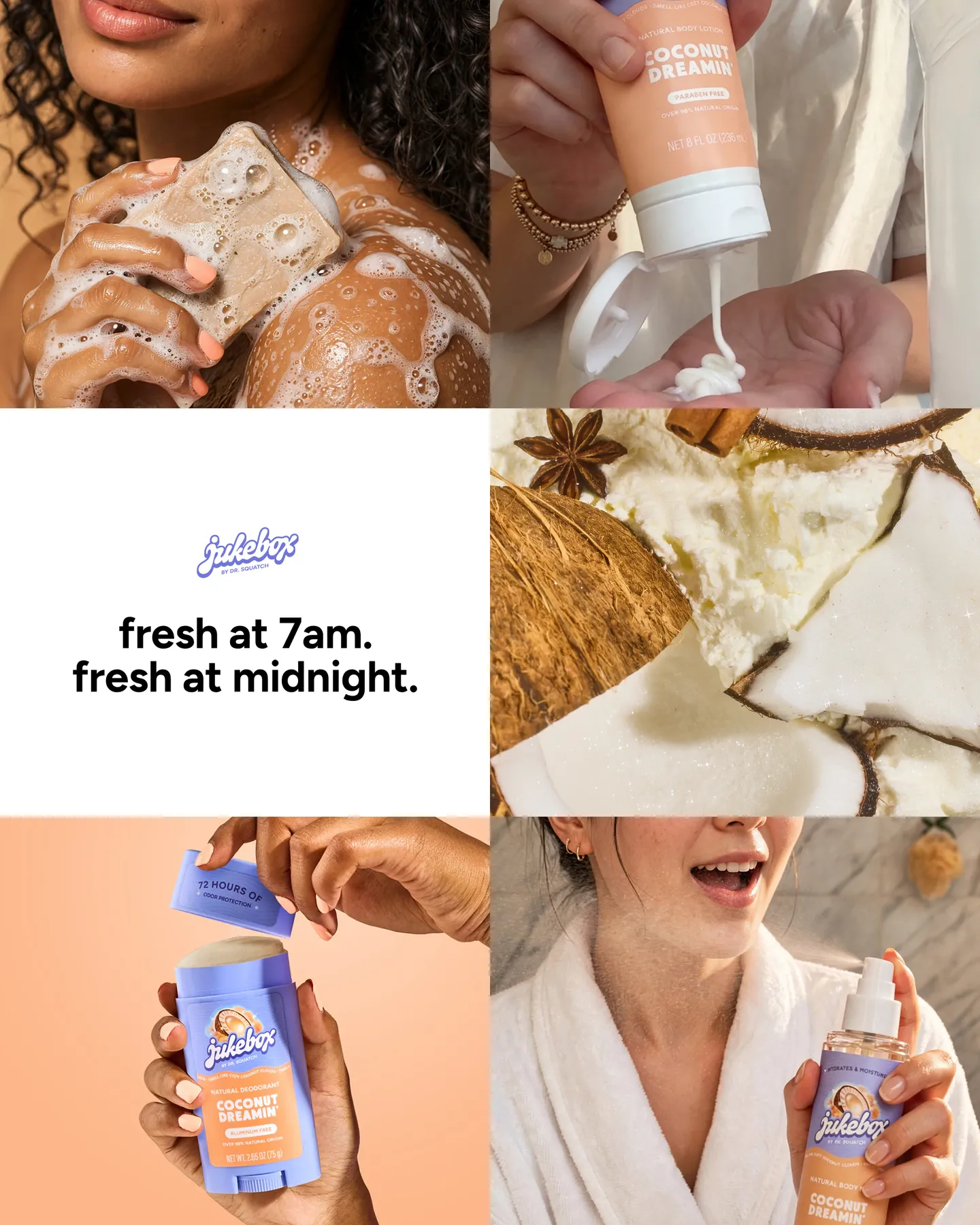
Jukebox is the women's body-care brand from the team behind Dr. Squatch. The line spans soap, deodorant, mist, and lotion; the hero offer in this study is the Coconut Dreamin' Scent Set - all four products in one scent, sold at myjukebox.com. The brand's own line: “Meet the full-body daydream… this set layers on the smooth, creamy scent of Coconut Dreamin' from head to toe. Over 98% natural origin ingredients.”
The offer
Coconut Dreamin' Scent Set - soap, deodorant, mist, and lotion in one scent, rated 4.9 stars across 525 reviews.
Who buys it
Women 18–26 who already buy natural-ingredient body care, read labels, and assemble routines from multiple brands. They shop ingredient-first and will interrogate a “natural” claim.
Price/objection shape
$43 for the set (marked down from $48), another 10% off first orders with WELCOME10, backed by a 30-day guarantee. The live objections are deodorant efficacy (“will this actually work at noon”), natural-claim skepticism from label readers, and scent commitment - four products in one untested scent.
The control
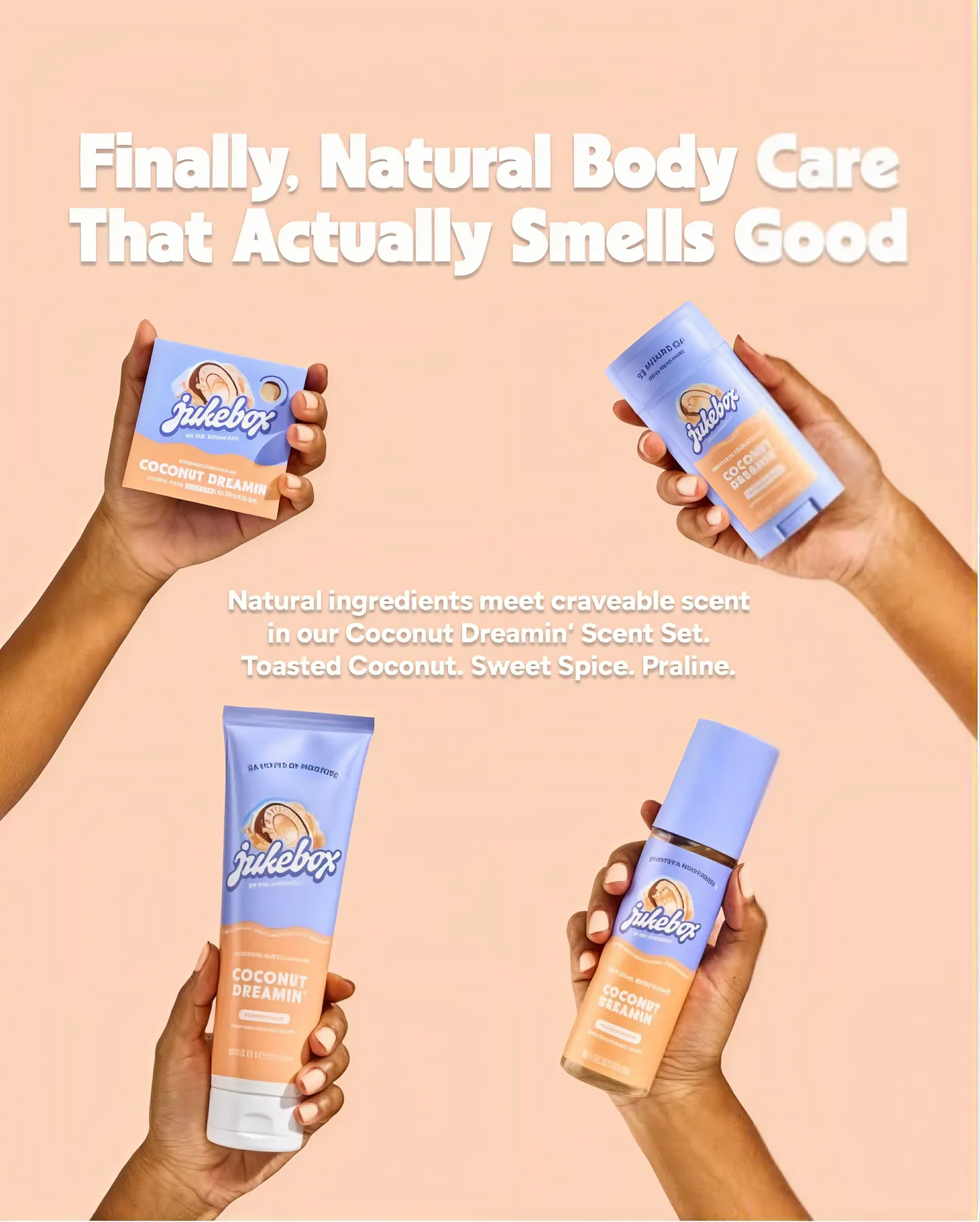
“Finally, Natural Body Care That Actually Smells Good” (Library ID 1046464238444470) - four hands holding the four Coconut Dreamin' products on peach; post copy “Four steps. One seriously dreamy scent.” The existing ad this study tests against. It was killed while this study was in progress.
Diagnosis
The read below is scoped to the account as captured - ~21 active image ads, no live creative for the set this study is built on. The account isn't missing creative; it's missing evergreen creative for its best-proven product. Each lens names a gap a test can close.
Lens 1Awareness levels covered vs. missing
Awareness level
Covered today?
What is missing
Unaware
No
Nothing names the fragmented-routine pain; the account opens at desire
Problem-aware
Thin
One old ad (“Upgrade your routine,” Jul 23); nothing current teaches the routine
Solution-aware
Partial
Sets exist (Best Sellers, Princess collection), but none frames one set as the single answer
Product-aware
Yes
Ingredient lists, scent notes, and Dr. Squatch borrowed trust speak to comparers
Most-aware
Yes
Limited editions, collabs, and WELCOME10 speak to buyers near the cart
Synthesis
The account opens at desire and novelty. The middle - the woman deciding whether one set can replace her multi-brand routine - gets one old ad.
Lens 2Formats used vs. unused
Used
Single-product drop statics, collab announcement statics, and set lineup shots; long post copy carrying scent notes, ingredients, and offer in one block.
Unused
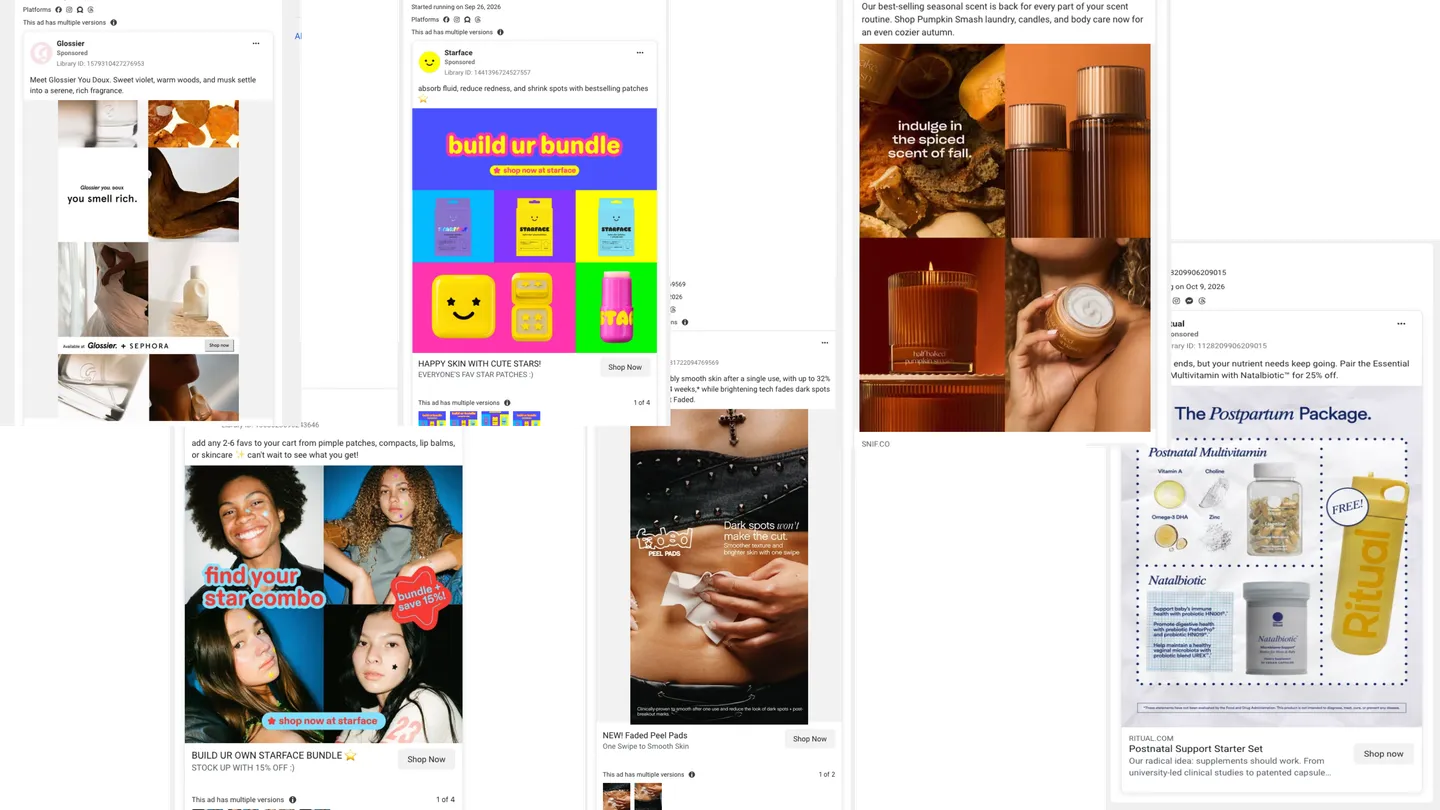
The in-use grid - four products shown being used, not lined up or announced. Nothing in the account shows the routine as a lived habit; the reference set (Glossier, Starface, Snif) proves the grid is the format the category rewards for multi-SKU stories.
Lens 3Positioning said out loud vs. left in the deck
Said out loud - by the control
“Finally, Natural Body Care That Actually Smells Good.” Natural-that-smells-good was the promise; “Four steps. One seriously dreamy scent.” led the post copy.
Said out loud - by the live account
“A NEW SCENT JUST RODE INTO TOWN.” “LIMITED EDITION.” What's live now announces novelty, not the routine.
Left unsaid
“The whole routine, one box.” Consolidation is the actual job - one brand, one scent, one box replacing a four-brand scavenger hunt - and with the control dead, no live creative says it. The set's proof (4.9 stars, 525 reviews, 30-day guarantee) has no ad carrying it.
Also left unsaid
In-use proof. Products are shown and announced; none are shown being used. For a buyer whose objection is “will this actually work at noon,” application is the proof.
Lens 4Customer language mined vs. generic
The strongest language in the account's copy at capture is procedural and sensory: “Lather, swipe, hydrate, spritz,” “smell like creamy coconut goodness from head to toe.” The generic failure mode is bundle-speak - “Complete your routine with four body care essentials” - which describes a cart, not a habit. The concepts below keep the procedural voice and push it into the headline: the routine named as one thing, the objections answered in the reader's own words.
Line
Source
Why it matters
“Finally, Natural Body Care That Actually Smells Good”
Control creative (Library ID 1046464238444470)
The control's headline - natural-that-smells-good as the lead promise
“Four steps. One seriously dreamy scent.”
Control post copy (Library ID 1046464238444470)
The control's post-copy lead - the routine named as steps
“Lather, swipe, hydrate, spritz”
Control post copy (Library ID 1046464238444470)
The routine as a procedure, not four products
“smell like creamy coconut goodness from head to toe”
Control post copy (Library ID 1046464238444470)
Sensory and full-body - the desire, stated plainly
“Meet the full-body daydream”
Product page
The set framed as one experience
“layers on the smooth, creamy scent of Coconut Dreamin' from head to toe”
Product page
Scent as the throughline across all four products
“Over 98% natural origin ingredients”
Product page
The proof the label reader is actually checking for
“swipe, sniff, and repeat for all day freshness”
Product page (deodorant)
In-use proof, in the brand's own procedural voice
“Complete your routine with four body care essentials”
Generic bundle-speak
The failure mode the concepts replace - it describes a cart, not a habit
Category proof
Three of the six cleared the 30-day line - Topicals, Snif, and the Starface combo. The two multi-product survivors both sell the system in a grid, not a lineup. The grid is the format the market keeps funding, and the in-use grid proposed in section 4 is Jukebox's version of it.
Pattern to verify - longevity
Which multi-SKU beauty ads have run 30+ days, and whether the survivors lead with the routine/bundle story or the single-hero-product story.
Pattern to verify - format reward
Whether the surviving multi-product ads use the grid/bento structure (Glossier, Starface, Snif) versus the lineup shot, and which structure the market keeps funding.
Position to take
If the surviving winners frame multiple products as one system, Jukebox's untested lane is the in-use grid: four products, one routine, shown being used - not lined up.
Longevity at capture (Oct 11)
Competitor
Library ID
Start date
Days live at capture
Topicals
27781722094769569
Aug 4, 2026
68
Snif
1057310903420502
Aug 13, 2026
59
Starface - “find your star combo”
1360623696243646
Aug 20, 2026
52
Glossier
1579310427276953
Sep 24, 2026
17
Starface - “build ur bundle”
1441396724527557
Sep 26, 2026
15
Ritual
1128209906209015
Oct 9, 2026
2
Test concepts
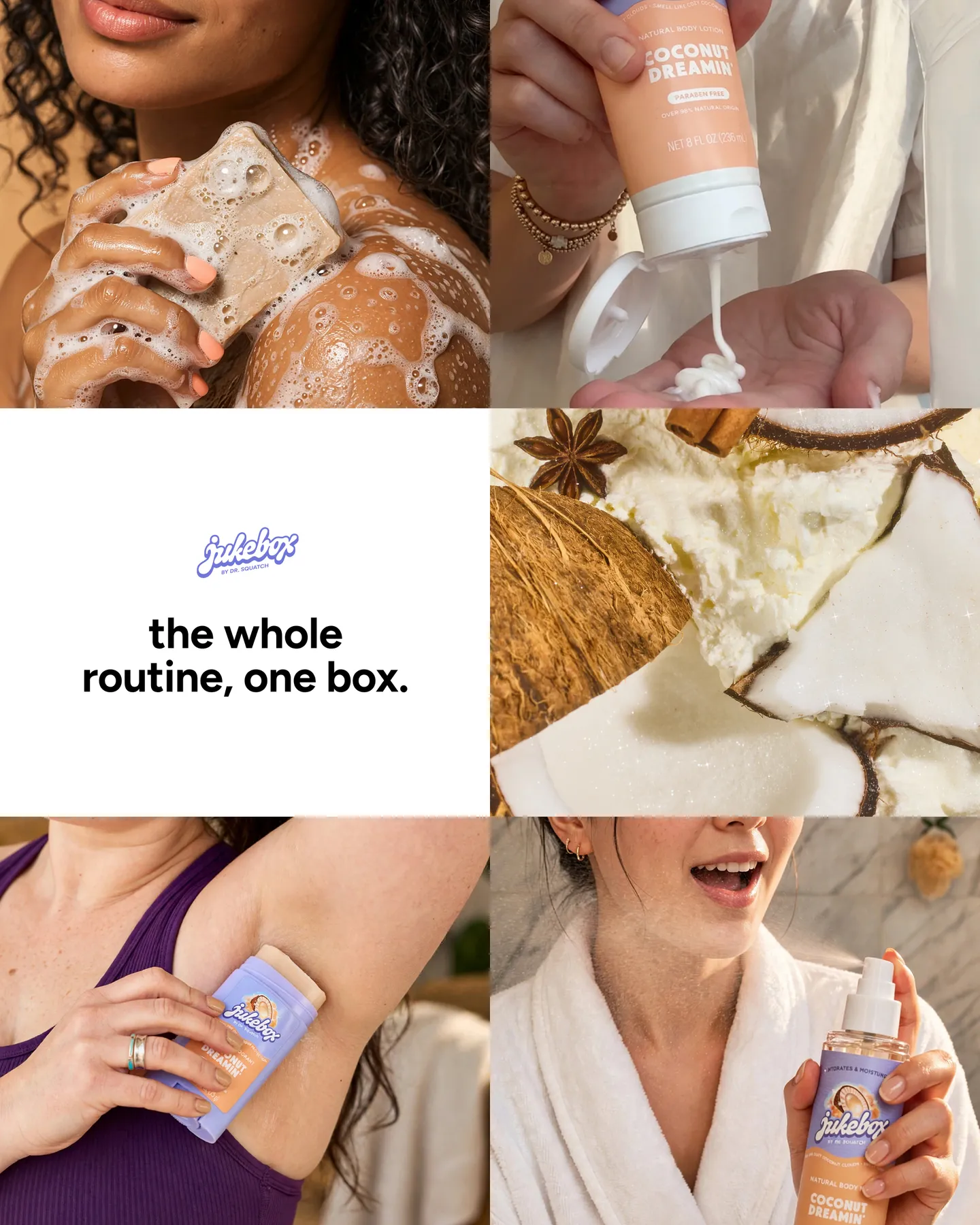
The concept round is already decided: the in-use grid (Concept A Variant) is the control - four products shown being used, coconut ingredient cell, headline in the white-space cell, Jukebox logo lockup. What follows is the hook round: identical grid, five headlines, each one mapped to a single objection from the Label Reader persona. Primary metric throughout: click-through rate to the set page, with landing-page conversion as the secondary read.
Variant 1The whole routine, one box. (control - claim)
Format
Grid static, 3×2 - four in-use product cells, coconut ingredient cell, headline in the white-space cell.
Persona + objection
The Label Reader, 18–26, solution-aware - no single objection; the baseline routine promise.
Awareness level
Solution-aware - she already buys natural body care; the ad consolidates her routine into one brand.
Headline
“the whole routine, one box.”
Hypothesis
Stating the consolidation promise flat - four products as one routine - beats the current scent-led control on CTR for a solution-aware buyer.
Held constant / judge on
Grid structure, all six cells, post copy, footer, CTA - only the headline moves across the five variants. Judge on: CTR (primary), page conversion (secondary).
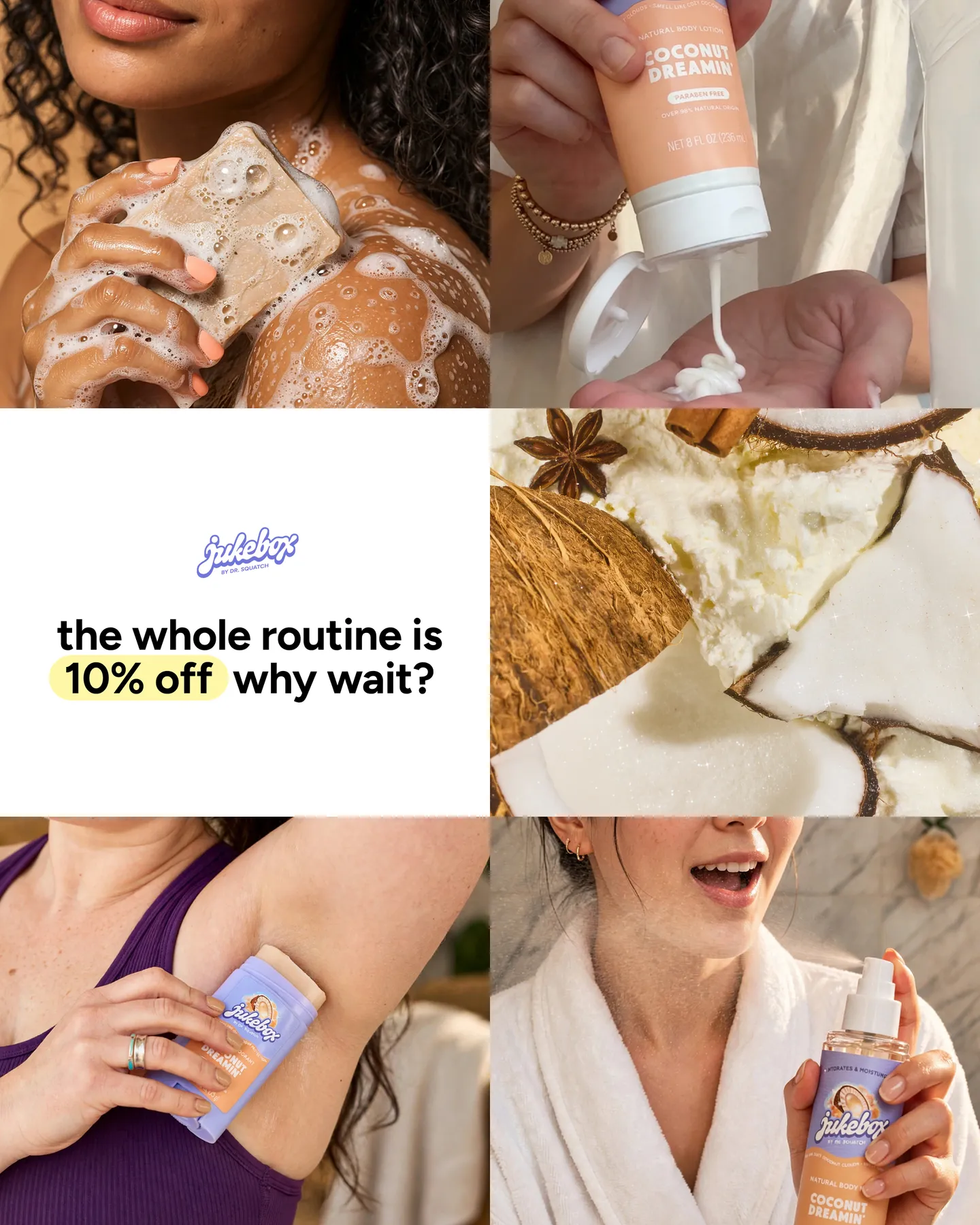
Variant 2The whole routine is 10% off - why wait? (question → commitment)
Format
Identical grid static - headline cell only changes.
Persona + objection
The Label Reader's commitment objection: “four products is a bigger leap than trying one”
Awareness level
Solution-aware - the leap, not the category, is the barrier.
Headline
“the whole routine is 10% off - why wait?” (10% highlighted)
Hypothesis
Framing the set as a discounted opportunity rather than a decision shrinks the commitment leap and beats the claim headline on CTR.
Held constant / judge on
Everything but the headline. Judge on: CTR (primary). Note: savings framing, not price framing - the set price never appears in the creative.
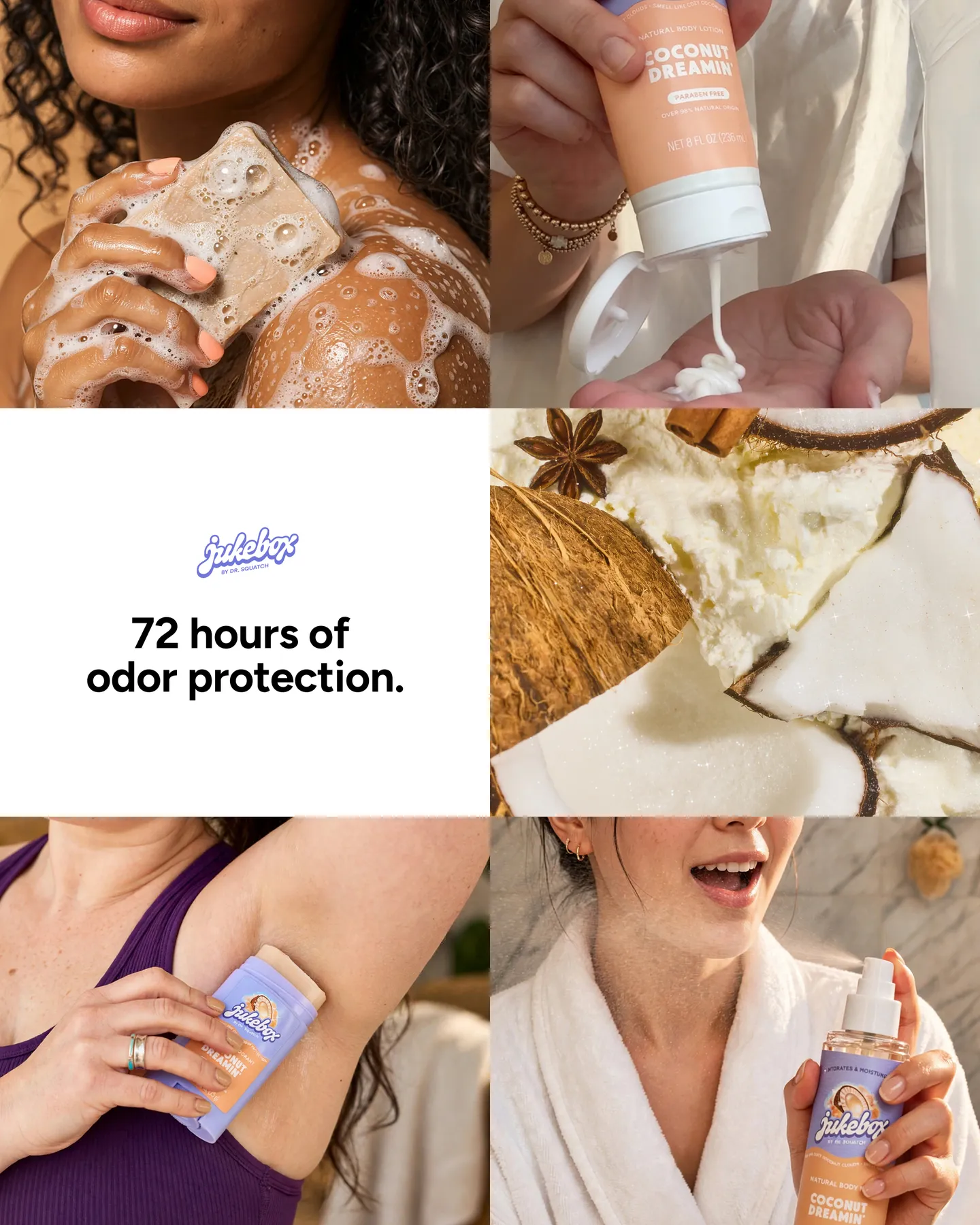
Variant 372 hours of odor protection. (number → longevity)
Format
Identical grid static - headline cell only changes.
Persona + objection
The Label Reader's longevity objection: “natural deodorant stops working by noon”
Awareness level
Solution-aware - she has been burned by natural deodorant before.
Headline
“72 hours of odor protection.” (verbatim from the deodorant cap)
Hypothesis
A specific protection number pulled from the packaging beats the routine claim on CTR because it answers the single objection most likely to kill the click.
Held constant / judge on
Everything but the headline. Judge on: CTR (primary).
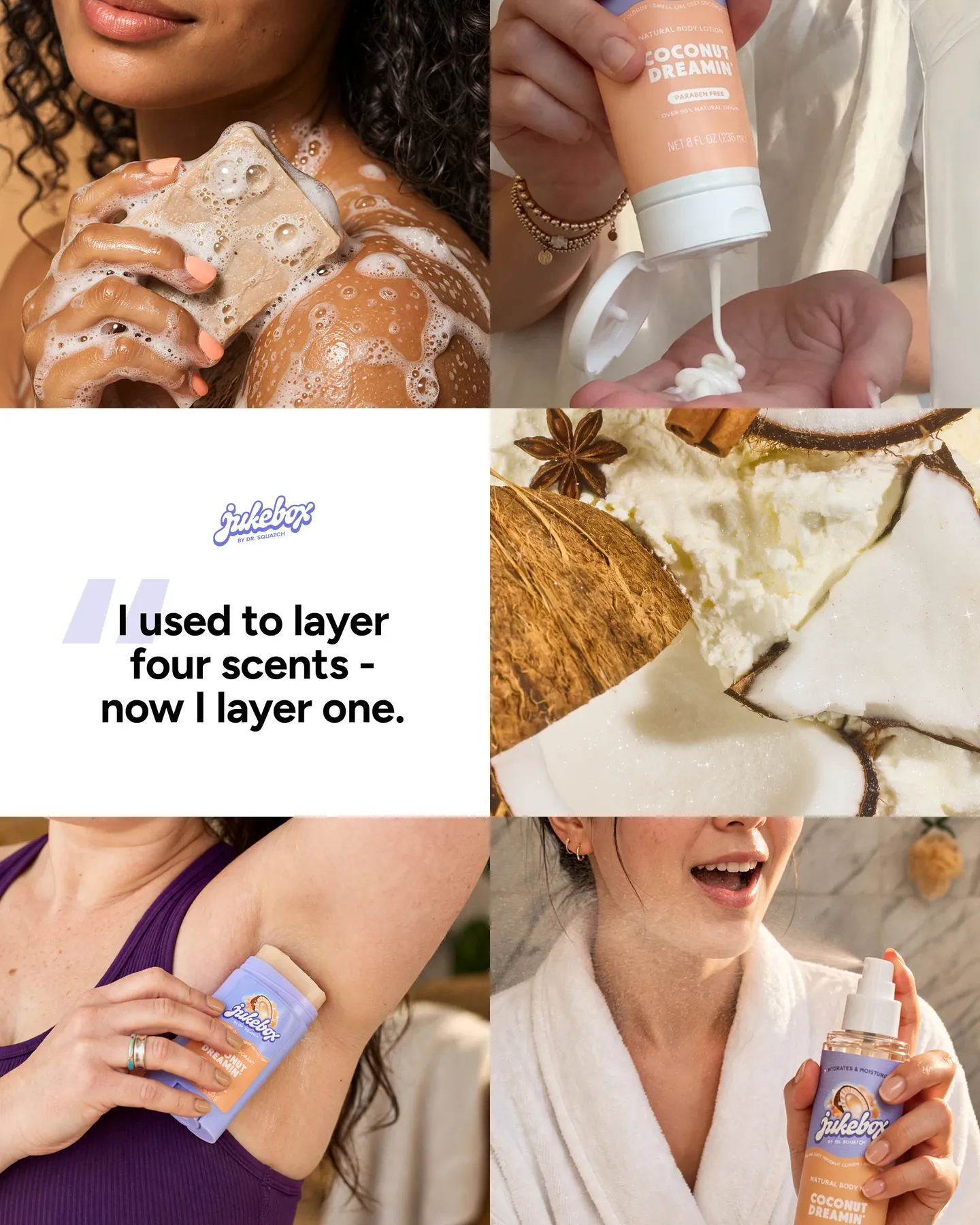
Variant 4I used to layer four scents. Now I layer one. (confession → scent conflict)
Format
Identical grid static - headline cell only changes.
Persona + objection
The Label Reader's scent objection: “four products means four conflicting scents”
Awareness level
Solution-aware - she currently mixes brands and smells it.
Headline
“I used to layer four scents. Now I layer one.”
Hypothesis
A first-person confession naming the multi-brand scent clash beats the routine claim on CTR because it voices the reader's current behavior back to her.
Held constant / judge on
Everything but the headline. Judge on: CTR (primary).
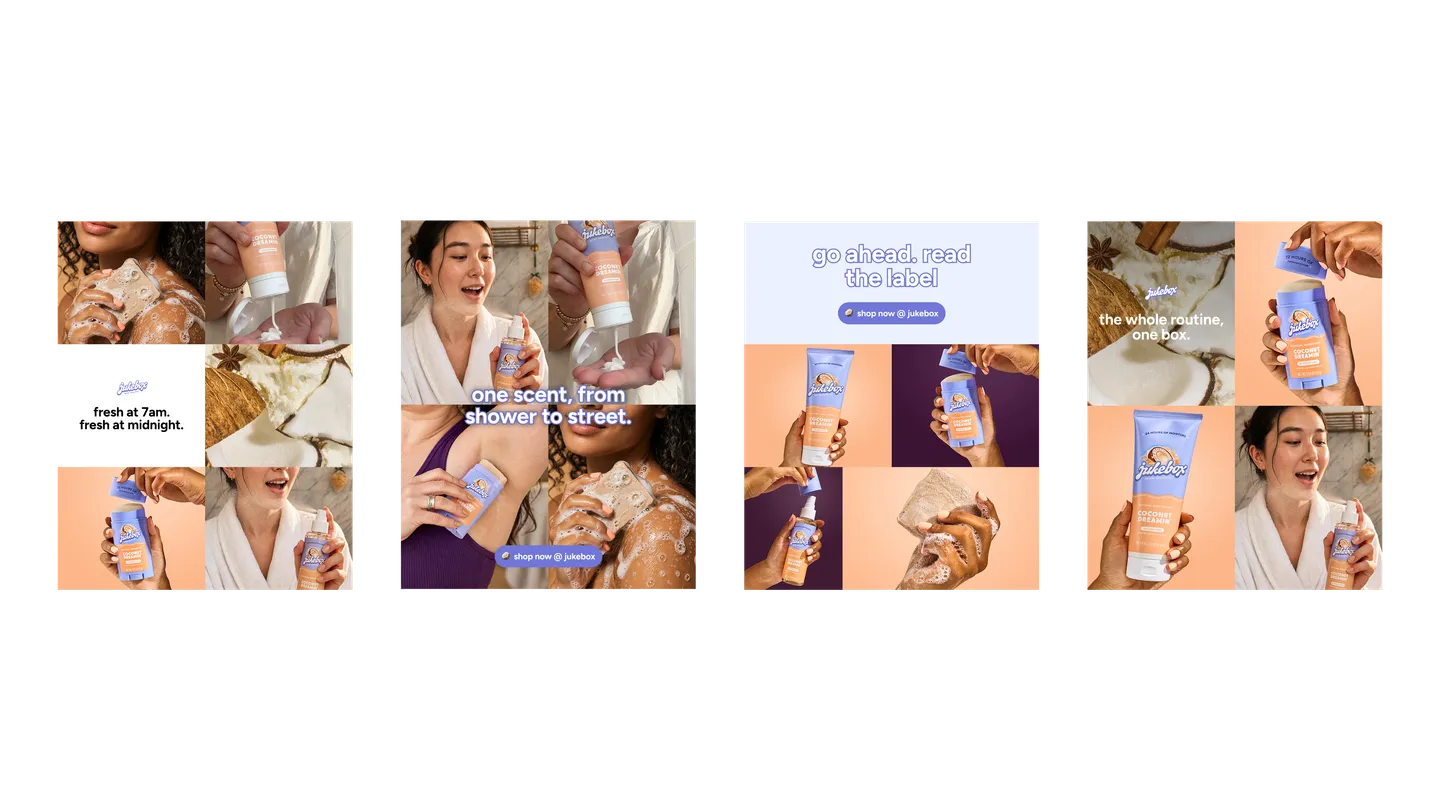
Variant 598% natural. Go ahead, read the label. (objection → ingredient scrutiny)

Format
Identical grid static - headline cell only changes.
Persona + objection
The Label Reader's ingredient objection: “'natural' won't survive my label check”
Awareness level
Solution-aware - she reads ingredient lists for sport.
Headline
“98% natural. go ahead, read the label.”
Hypothesis
Inviting the label check instead of fearing it beats the routine claim on CTR for the ingredient-skeptical segment - the dare is the filter.
Held constant / judge on
Everything but the headline. Judge on: CTR (primary).
The sensitive-skin objection (“new formulas may irritate”) sits out this test so the read stays clean; it becomes the sixth variant once one of these five moves.
Test plan
The sequence: concept first, then hook, then format. A hook tested on a weak concept wastes spend; a format tested before the hook is known confuses the read.
Round
Question
What moves
1. Concept
Which structure sells the routine?
In-use grid - decided: the grid is the control
2. Hook
Which objection is the live blocker?
Headline only - claim, question, number, confession, objection (the five variants above)
3. Format
What carries the winner furthest?
Grid density, ingredient cell vs. fifth product moment, white-space headline vs. overlaid
Cadence
One round at a time, 100 link clicks per variant before any kill call, reads taken on calendar days not partial days, no edits mid-round.
How winners become the new control
A variant that clears 1.3× the control's CTR across two consecutive days is promoted to control - provided its landing-page conversion rate holds at or above the control's. A curiosity-gap headline that wins clicks and tanks purchases doesn't scale. The next round tests against the new control, and the beaten control is retired to the swipe file with its numbers attached.
What feeds round three
Inside the winning headline, the grid cells become the variable - which in-use moment leads, whether the ingredient cell earns its slot, and where the headline cell sits in the reading order.
Sources
Next
Tripleseat